Yes and Hesse and Old Age


A few weeks ago, I wrote a piece about Spinoza and the value of cheerfulness. I took some criticism for promoting baseless optimism; surely this is not what I (or Spinoza) intended. Let me try again.

Cheerfulness is a way of saying yes to what life presents. Think of Molly Bloom saying yes to life and all it entails. Remember Paul telling the Corinthians that Jesus was never about yes or no, but always about yes. Consider Nietzsche sharing his “highest insight”:

This final, most joyful, effusive, high-spirited yes to life is not only the highest insight; it is also the most profound, the most rigorously confirmed and supported by truth and study. Nothing in existence should be excluded, nothing is dispensable …. To understand this requires courage….

Yes! An affirmation of life, the start to approaching life with… cheerfulness. As one definition has it: an ungrudging attitude toward life.
One of the best (and most neglected) writings on old age is a collection (Hymn to Old Age) that Hermann Hesse pulled together from his own letters and other writings. At age seventy-five, Hesse talks about getting to yes in regard to life – and specifically in regard to old age:

An old man who only hates his white hair and his proximity to death is as unworthy a representative of this phase of life as a young, strong man who hates his job and his daily work and tries to get out of them. In brief, if an old man is to achieve his goal and do justice to his task, he must be in accord with age and everything that age brings with it – he must say yes to all of it. Without this yes, without acceptance of what nature demands of us, we lose the value and sense of all our days – whether we are old or young – and we betray life.

Hesse is thought of as a great influence on the young. We all read Siddhartha and Steppenwolf when we were young. If we were lucky we read Glass Bead Game when we were a little older. But Hesse lived to be eighty-five and he had what seems to be an admirable old age. And he “gratefully give(s) names to the gifts that are given to us by age”:

For me the dearest of all these gifts is the treasure of images which after a long life we carry in our memory, and to which with the decline of our active powers we turn with a different attitude from ever before…. Looking, observing and contemplating increasingly becomes a habit, an exercise, and imperceptibly the mood and approach of the watcher permeates all our actions… today, gently leafing through the great picture book of our own life, we are amazed at how good and beautiful it can be to have escaped the hunt and the headlong rush and to have landed safely in the vita contemplativa. Here, in this garden of old men, many flowers blossom which earlier we would never have thought of cultivating. There blooms the flower of patience, a noble plant, and we become calmer, more tolerant, and the less we insist on actively intervening, the greater becomes our ability to watch and listen to the life of nature and the lives of our fellow humans, and to let it all pass us by without criticism but with renewed amazement at the vast diversity, sometimes taking part or silently regretting, and sometimes laughing with shining joy and humour.

Hesse “gratefully give(s) names to the gifts that are given to us by age.” One might compare Eliot’s “gifts reserved for old age” from “Little Gidding.” Eliot’s gifts are mostly in the negative, he’s not nearly as… cheerful as Hesse. Hesse says yes to it all. Hesse is realistic, though; his paean to old age includes the aches and pains and disappointments of himself and his fellow travelers. But in the end: “Age is not worse than youth; Lao Tse is not worse than Buddha. Blue is not worse than red. Age is only pathetic when it wants to play at being young.”

Interestingly, Hesse wrote an early novel (while in his thirties) about the old called In the Old Sun. It is good, but does not have the ring of truth we find in the selections from A Hymn to Old Age. In the latter, Hesse has been to the mountaintop and back down to the valley – and he is still cheerful.

This week I have posted the story “The More Loving One,” with a nod to Auden.  It is about a dying father’s gift to his daughter, a gift that has to do with saying “yes.”


Second Growth

For anyone interested in the process of aging, one could do worse than perusing Ralph Waldo Emerson’s journals. Emerson lived to be almost seventy-nine, and kept a journal between the ages of seventeen and seventy-two. Not only do we read about his transit through time, but he relates the development and aging of his friends – and Emerson’s friends were wonderful people indeed.

I have conscientiously kept a journal for the past fifteen years; in the writing, it has been therapeutic; in its existence (particularly with the aid of the word processor’s search feature), it has been an aid to memory; in its chronology, it has helped me understand my own journey through time. I wish, though, that I had such documentation of earlier crises in my life, as I rely on my memory – both historical and emotional – to try to make some sense out of things retrospectively, which I believe is part of the mission of old age. And one’s own memory can be a sly fox. Of course, there remains the problem of what to do with the written details of one’s life and thought when the end of life (or mind) comes, but for now it is a priceless resource (to me). More on this in another post (as well as hints as to how to journal consistently), but back to Emerson.

In a journal entry that Emerson made in February 1862 (he was fifty-seven), he gives us his thoughts on a second growth in old age, as well as a comment from his friend Thoreau (what wouldn’t you give to go on a long walk with those two?):

[Oliver Wendell] Holmes came out late in life with a strong sustained growth for two or three years, like the old pear trees which have done nothing for ten years, and at last begin to grow great. The Lowells come forward slowly, and Henry Thoreau remarks that men may have two growths like pear trees.

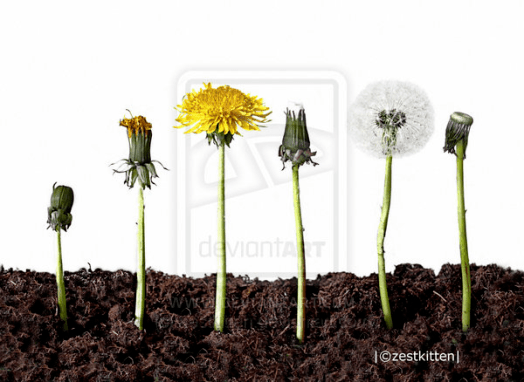
And this got me thinking about… dandelions. For one thing, it is that time of year in North Carolina. For another, dandelions have two “growths,” two “blossomings.” One day on a walk, I began wondering about dandelions (having seen a wonderful crop of them). How do they metamorphose from a yellow bloom to a white one with no “transitional” blossoms? As I got down on my haunches and investigated more closely, it seemed that the golden bloom closed up again and then reopened as the white feathery blossom – I found this diagram of the dandelion life cycle:

dandelion


So, the blossom is twice born – once to youth, beauty, color, and sexual purpose (attracting those bees), and the second time to lightness, airiness, ultimate dispersal, and perhaps rebirth. In-between, there is a period of rest, a closing down, a respite. It might behoove us to think of our whitening heads as such a second flowering.

For those of you interested in Emerson’s journals (which are voluminous), I recommend the abbreviated Heart of Emerson’s Journals, edited by Bliss Perry. For those of you interested in Emerson’s life, I recommend Mr. Emerson’s Wife, by my friend Amy Belding Brown.

For a story this week, you might go back to “Again and Again and Again” for a tale of Walden Pond, or you can read the prospectus for a novel (I actually did write the novel several years later), included here as “A New Fable of Old Age.” This started as a thought experiment in which the old are forced into a second growth. I apologize for my tardiness in posting this time; we have been visiting our elderly mothers. Perhaps more about that too at a later date.


Teach Your Children Well?

Teach your children well,
Their father’s hell did slowly go by,
And feed them on your dreams,
The one they pick’s the one you’ll know by.

Anyone who has been a parent (or a grandparent or an aunt or uncle) knows how hard it is to “teach our children well,” how frustrating it is to helplessly watch young people make the same mistakes we made. There is a memorable passage from Willa Cather’s One of Ours in which an older man tries to warn the young Claude against a bad marriage:

He found himself absolutely unable to touch upon the vast body of experience he wished to communicate to Claude. It lay in his chest like a physical misery, and the desire to speak struggled there. But he had no words, no way to make himself understood. He had no argument to present. What he wanted to do was to hold up life as he had found it, like a picture, to his young friend; to warn him, without explanation, against certain heart-breaking disappointments. It could not be done, he saw. The dead might as well try to speak to the living as the old to the young. The only way that Claude could ever come to share his secret, was to live.

“The only way …was to live.” That is the answer we come to, isn’t it? The only teacher is experience, and yet we wish we could prevent their mistakes, their heartbreak. And Claude does end up broken-hearted.

Of course, these days, we often find ourselves learning from the young. Technology is the best example; we are forever having our computers and digital televisions fixed or explained by someone far younger. I don’t mind; they know the language and I am grateful to have a translator. Sometimes I wonder, though, whether our technical and cultural laggedness does not make young people assume we have nothing to share. Because on issues of the uses of youth, on the dangers of dayspring mishandled, I do so wish I could spare them “heart-breaking disappointments.”

There were other eras when the youth held knowledge the old did not have. As education and literacy started to spread in 18th century England, younger members of the household – the children and grandchildren – could read the new broadsides and chapbooks that their elders could not decipher. Families often gathered by the fire to be read to by the young. At the same time, increasing literacy and the proliferation of books meant that the memory of the elders was not as important as it had been. One could get an almanac with planting times, rather than relying on Grandpa’s experience.

So, in the face of all that, what do we have to teach? Of course, the old person has always served as a memento mori for the young – a living reminder of how (unless science comes up with a cure for aging and death) they will end up, given time. Time. The fourth dimension. We have gained experience over time, and have lived long enough to know how it is when passion is spent, the consequences of decisions (or the failure to make decisions), what is harvested after a long and punishing season of plowing and planting. As we are running out of time, it is time we want to give the young experience of, but it is not easy. Where I feel this lack most is in environmental issues; our generation participated in enjoying the resources of this world without taking account of what would happen over time. Now we know and weep. But more on the old and the environment in another post. And I might note that while we are interested in teaching the young about the consequences of time, they are interested in how it feels to live without time.

This week we have all been learning from the young students from Parkland as they march on Washington, believe changes can be made, refuse to be taught acceptance or pessimism, and insist on grasping the present moment. Bless them. They have learned from us, but not as elders – they have learned from our younger selves, our actions in the sixties and early seventies when we marched against the Vietnam War, rallied against segregation, burned our bras, and didn’t trust anyone over thirty. And they have much to teach us about remembering.

Graham Nash finishes his song by admonishing the young to “teach their parents well”:

And you, of tender years,
Can’t know the fears that your elders grew by,
And so please help them with your youth,
They seek the truth before they can die.
Teach your parents well,
Their children’s hell will slowly go by,
And feed them on your dreams
The one they pick’s, the one you’ll know by.

This week’s story, “Any Help She Can Get” gives us a younger person whose desperation forces her to learn from the very old and the very young. May we all be open to the wisdom of age and the vitality of youth.


Learning in Old Age – What Do You Say?

Learning is good, you say.  Our culture encourages old people to pick up new skills, new knowledge.  And there are countless “senior” universities and elder learning/travel programs to help us along.  OK.  But let’s think for a minute about what Seneca said (and Montaigne quoted in his wonderful essay, “All Things in Their Season”):  “An old man learning his ABC is a disgraceful and absurd object; the young man must store up, the old man must use.”  Seneca is commenting here on Cato’s learning Greek for the first time in his old age.  And Montaigne goes on to say “the greatest vice they [the wise] observe in us [old people] is that our desires incessantly grow young again; we are always re-beginning to live.”

The current popular opinion is it is never too late to learn something (if not everything) and this is a very American sentiment.  Here is Emerson at age sixty-nine writing in his journal:  “I thought to-day, in these rare seaside woods, that if absolute leisure were offered me, I should run to the college or the scientific school which offered [the] best lectures on Geology, Chemistry, Minerals, Botany, and seek to make the alphabets of those sciences clear to me.  How could leisure or labour be better employed?”  And so we go on educational cruises and enroll in sign language classes, spending our money and filling our time.  Me too.  There’s nothing really wrong with it, but it bears thinking about.  “The young man must store up, the old man must use.”  That phrase haunts me.

Maybe there is a middle way.  In an essay on reading the classics, Italo Calvino recommends:

There should therefore be a time in adult life devoted to revisiting the most important books of our youth.  Even if the books have remained the same… we have most certainly changed, and our encounter will be an entirely new thing…Every rereading of a classic is as much a voyage of discovery as the first reading.

Rediscovering what we already knew – and doing it ourselves without being told what the academy thinks it means.  For anyone interested in such an endeavor, I recommend finding a Great Books group (all the people in it will be old, I can assure you) in which you deal with the text and there are no experts or outside sources.  Similarly, I moved from taking piano lessons to meeting monthly with other amateurs like myself; we learn pieces to play for each other and discuss.   I participate in a neighborhood yoga group which is simply a group of willing participants.  In all these groups, we teach each other and we teach ourselves.

I am not denigrating classes and travel; I am trying to differentiate learning as a distraction from plumbing the depths of our experience to realize what, perhaps, we already know.  I want to distinguish between taking in regurgitated “professional” knowledge and developing our own capabilities, our own wisdom.  What did the fool say to Lear?  “Thou shouldst not have been old till thou hadst been wise.”  Perhaps I will try to define wisdom in some future post, but I think we know what it feels like.

In a different essay, Seneca discusses people who are looking for gems as they read, wrapping up nuggets of learning to represent their effort – something that is fine for children, but the older person should be doing something else:

But for a man advanced in study to hunt such gems is disgraceful; he is using a handful of clichés for a prop and leaning on his memory; by now he should stand on his own two feet.  He should be producing bons mots, not remembering them.  It is disgraceful for an old man or one in sight of old age to be wise by the book.  “Zeno said this.”  What do you say?  “This Cleanthes said.”  What do you say?

What do you say?

Note: To preempt your justified criticism, I know I am guilty of relying on “nuggets of learning.”  Most of them come from notes and journals I have been keeping for decades, but I endeavor to contemplate them rather than “lean” on them!

Renoir, de Beauvoir, and the Artist of Kouroo

In 2012, there was a film made about the old age of Renoir. The film was lovely, but painful to watch, as Renoir coped with rheumatoid arthritis as he kept on painting, having to have assistants wrap his fingers around the brush to get him started. Possible for Renoir, perhaps, because he had the fame and fortune to get much support and respect, even though he was greatly debilitated. No nursing home for him. But still inspiring and lovely – pursing his project to the end.

In her La Vieillesse (interestingly, a French feminine noun meaning “old age,” but translated in the English version to The Coming of Age), de Beauvoir says that “there is only one solution if old age is not to be an absurd parody of our former life, and that is to go on pursuing ends that give our existence a meaning – devotion to individuals, to groups or to causes, social, political, intellectual or creative work. In spite of the moralists’ opinion to the contrary, in old age we should wish still to have passions strong enough to prevent us turning in upon ourselves.” Yes. But. She also says (and all of this is in her conclusion to the book) it is fairly inevitable that “illusions” will vanish and “one’s zeal for life pass away.” Therefore, we shouldn’t think too much but just continue in established “paths.” De Beauvoir does not think much of retirement.

De Beauvoir tells us the retired, “even if he keeps his health and clarity of mind…is nevertheless the victim of that terrible curse, boredom.” How afraid we are of being bored! What did Pascal say? “All men’s miseries derive from not being able to sit in a quiet room alone.” And what did Kafka say? “You do not need to leave your room. Remain sitting at your table and listen. Do not even listen, simply wait, be quiet, still and solitary. The world will freely offer itself to you to be unmasked, it has no choice, it will roll in ecstasy at your feet.” When on earth do we get a chance to sit alone and listen if not in old age, in retirement? Is it such a terrible curse? And what about people (like athletes) whose passions are dependent on a functioning body? My folks were devoted to tennis and desolate when they could not play.

There is more to it. De Beauvoir says that in old age we are overwhelmed by the past, as there is so much of it. She talks about the “hard apprenticeship” of childhood and the fact that “the unpleasant memories of this time that were repressed in adulthood [by ceaseless activity] revive in old age. The barriers that stood up well enough so long as the individual was active and subject to social pressure give way to the lonely idleness of old age.” Isn’t this a good thing (not the loneliness, perhaps, but the time to reflect)? Do we want to die with these barriers in place?   (This is a very good question, and my readers may have very different answers.)

This is one of those divergent problems (see Schumacher’s Guide for the Perplexed for a good definition of divergent and convergent problems) – for which there are only contingent answers. Surely we should pursue projects that engage us, challenge us. And this makes me think of Thoreau and his Artist of Kouroo. I don’t know if HDT heard this fable somewhere or made it up, but in Walden, he gives us an artist “who was disposed to strive after perfection. One day it came into his mind to make a staff. Having considered that in an imperfect work time is an ingredient, but into a perfect work time does not enter, he said to himself, It shall be perfect in all respects, though I should do nothing else in my life.” The artist works and works, through endless eons of time, until he had a pure and faultless creation and “he saw by the heap of shavings still fresh at his feet, that, for him and his work, the former lapse of time had been an illusion.” In true creative engagement, time falls away. “His singleness of purpose and resolution, and his elevated piety, endowed him, without his knowledge, with perennial youth.” Perennial youth. But, when one puts the brush or the pen or the carving knife down, doesn’t one still have to deal with the aging body? May we always have projects ahead of us, but may we also be prepared to just sit – when we want to and when we have no choice.

This week’s story (“Every Winged Bird According to Its Kind”) is a part of my Metamorphoses series and concerns an old woman who has found a modest project, an object of engagement, in her old age.


Smile for Spinoza

When  thirty-two year old Jonathan Swift wrote the resolutions after which this blog is entitled (“When I Come to be Old”), he included the determination “not to be peevish or morose, or suspicious” on his list. At the end of his list he confessed he feared that, although he set up rules for his senescence, he “would observe none.” And so it was. Jonathan Swift was not a happy old man.

I got to thinking about positivity and cheerfulness as I read the cover article on this week’s NY Times Book Review, entitled “Put on a Happy Face,” which reviewed books that took an optimistic view of the world (a difficult task in present times, but apparently not impossible). In particular, it made me muse about the value of cheerfulness in old age, and it reminded me of something Spinoza said.

Spinoza led a hard life; he grew up Portuguese Jewish community in Holland, but was ex-communicated by his own people for his philosophical work. In his Ethics (1677), he strives to outline a rational basis for life, in the course of which he demonstrates the value of …cheerfulness. “Cheerfulness cannot be excessive, but is always good; melancholy, on the other hand, is always evil.” This makes sense to me. In the previous section, Spinoza had elaborated on how he came to his conclusion: “Joy is an affect [emotion] by which the body’s power of acting is increased or aided. Sadness, of the other hand, is an affect by which the body’s power of acting is diminished or restrained.” In other words, it makes sense to be happy, cheerful, positive. Cheerful people have more energy, more “power.” Sadness weighs us down, “restrains” us.

I remember an older man I worked with who was somewhat inept and clumsy, and not too awfully bright. But he was a ray of sunshine each and every day. Everything was going to be terrific, he thought you looked great today, and wasn’t it a beautiful day? Jim’s concrete contributions to the team were minimal, but no one ever suggested getting rid of him. His emotional support was priceless. The tag I use on my e-mail is from Thoreau and sometimes reminds me of Jim: “To affect the quality of the day, that is the highest of arts.”

Old people do not have a reputation for being particularly cheerful. Old men are often characterized as grumpy and old women as crabby – not universally or accurately labeled, yet the stereotype is there. A question worth exploring might be: How does one maintain an attitude of optimism and cheerfulness as one ages, when (perhaps) the joints hurt, the teeth ache, the mirror mocks, and the pension is not keeping up with inflation?   I don’t think it can be done if we are fighting what is happening to us; warriors are not cheerful. But (perhaps) if we can accept the ride down, we might consider some words of Rilke:

And we, who always think
of happiness as rising feel the emotion
that almost overwhelms us
whenever a happy thing falls..

There can be, I think, happiness in the fall if one does not insist that one is not going to fall (while all the time headed down the rabbit hole).

Spinoza infers cheerfulness is its own reward. It increases “the power of acting.” And the people around us like it. But it is not always easy. “Smile though your heart is aching” advises the words of the song by that sad little tramp, Charlie Chaplin. Cheerfulness can’t just be a façade, nor can it be a blind optimism. You need to believe that there is some happiness in the fall, and you have to believe in the efficacy of a smile. And if your smile is not initially wholly sincere, an habitual cheerfulness might actually lead to a happier life. And that would certainly be something to smile about.

None of this is meant to minimize the effect of clinical depression or deep and justified sadness. But our attitude toward life is worth examining once in a while. This week’s story (“Snickerdoodles”) is about an older person who sees a vision of a more positive life (with Chaucer’s help) in the midst of change and loss. Her revelation comes while baking cookies; we will have to find our own catalyst.

The Notion of Progress and the Reality of Aging

How does aging fit in with the narrative of progress in which we are immersed? One can wonder about what progress really is or means (G. K. Chesterton: “Progress should mean that we are always changing the world to fit the vision, instead we are always changing the vision”) or marvel at the reversal of the Enlightenment period from the old story of decline from the Golden Age to expectations of ever-better lives, technologies, civilizations (J. B. Bury: “Between 1690 and 1740 the conception of an indefinite progress of enlightenment had been making its way”). Regardless of how we define it or how it arrived, we now live in a world that sees itself as progressing; we participate in a world that expects people to improve themselves; we flail around in a world that offers us visions of innovation and perfectibility.

Humanity did not necessarily start with a progress narrative; ancient stories often depicted a fall from a golden era (think Eden or the Golden Age (which the Greeks said were followed by the inferior Silver, Bronze and Iron ages). In this old story, the trajectory of a human life followed the pattern of the cosmos. Childhood and youth were a kind of Eden; loss of innocence was followed in a few years by many other losses. With the Enlightenment and the advent of a progress narrative, humanity found optimism in a future which included scientific advancement and expanded life spans. Things were only going to get better. Celestial immortality was replaced by the hope of infinite mortality. Yet, people still age. More slowly, perhaps, and certainly for a longer time span than did our ancestors. And yet – we age and wane in a world that does not seem to have a narrative of decline.

What does one do with a body (despite periodic repairs in organs and skin tone) which is on a downward trajectory? And what about the mind that might be wiser, but is slower and more forgetful? What do we do with the discrepancy between the decline of the individual body and the ideology of progress? The “ideal” of the Enlightenment was progress; this collective advancement was hard to reconcile either in fact or metaphor with the reality of the aging of an individual. And no one seems to want to help us (other than by selling us things to make us look or feel younger). We are exhorted to keep up with things, stay busy, see the world, look younger, eat strategically and beat the odds. The day comes, of course, when we can’t keep up, don’t want to be busy, look old, and face undeniable omens of mortality. And often the terminology used is that of failure: “She’s losing her fight against gravity.” “He doesn’t even try any more.” “She wears old lady clothes.” “She’s given up.”

I am no Luddite. Science has certainly given us longer and healthier lives, but it has not given us an allegory, a template, for growing old. Science does not grow old; it renews and adapts itself continually. Technology, science’s step-child, not only moves steadily forward, but is commercially insistent that we all come along for the ride. If we cannot keep up, we are “behind the times.” How can we be behind the times we are living in? And if we are (and see this week’s story, “The Needs of the Living Organism”), is that entirely a bad thing? Might those outside the circus be the only ones who can see objectively the frenetic activity in the three rings under the big top? Might we not appreciate this as a good place to be? (Think of Lear’s plan for his old age at the end of the bard’s play – but more on King Lear next time.)

When I left the commerce of the working world, I was relieved I would not have to learn another computer update, not have to adjust again to whole new ways of getting the job done. My generation – who entered the work world before computers and just slightly after Xerox machines – adapted to a great deal and did it well. But is learning a new technology really a growth experience? Given a choice in old age, might we not want to spend our time learning other things? Or reflecting on what it means to have spent so much of our lives learning and adapting to ever-changing tools – and wondering whether that effort minimized our better understanding of what those tools were used for. We might decide the Enlightenment notion of progress is something we can transcend; indeed, it might be one of the things that old age is for.

The Sacred Book

Books are wonderful. I learned at a very young age that there is nothing better than a good book.   Books were the things, besides the body, that seemed to transcend every transition in life. I married, had children changed husbands, launched kids, moved houses – but there were always the books. A mystified coworker (who could not believe I spent precious vacation time going somewhere to talk about books) once gave me a sweatshirt that said: “So many books, so little time.” Yes, indeed.

I thought you could learn anything from a book. My father may have been the culprit on this. He built his first house  out of a book entitled Your Dream Home: How to Build it for Less than $3,500 – very popular with GI’s who came home after World War II. My father read the book and he built a house. He had some help and the house had its problems, but the book told him what he needed to know, and – more than that – it convinced him it was possible. In later years, he used books to teach himself to sail, play chess, and to build a fireplace with rocks that he picked up on the beach. I have a clear memory of all of us standing around the massive hearth, where misshapen rocks were held together with a little more concrete than you might see in more professional masonry, and holding our breaths as we waited to see whether it would draw smoke. And it did. Again, not perfectly, but well enough for the man who was so proud of it. You could learn anything out of books.

Over the years I used books for a variety of reasons. I wore out my Dr. Spock while raising children and I am on my second red Betty Crocker cookbook.  I learned to knit and crochet with books; I taught myself enough French to pass the second-language translation test for a graduate degree I used books to plan trips, bake bread, grow roses, sew curtains, buy cars, set up a retirement account, research almost anything I was interested in.

Of course, the obvious extrapolation from all of this textual success was that the same vehicles that taught me information and crafts, that delivered me safely where I wanted to go and told me if my child had the chicken pox, could also teach me how to live a happy, peaceful life, could free me from irrational fears (hypochondria, catastrophic thinking) and rational fears (death and global warming), could help me adjust to old age. So, I read great books, self-help books, spiritual memoirs, important works in psychology and philosophy and popular works of psychobabble. I ran through subjects and authors. Still I could not read myself into faith or peace or self-acceptance. But I kept trying. If the original story were true, it was just a matter of reading the right book, wasn’t it? And I had always thought there could not be enough books, but perhaps we should remember what the Preacher says (in Ecclesiastes, one of my favorite books of the Bible): “And further, by these, my son, be admonished: of making many books there is no end; and much study is a weariness of the flesh.”

So my faith in books had some holes in it. It is clear, while I have learned much on a “technical” level, there is something that books have not been able to give me. I have wandered and thirsted through Borges’ labyrinthine libraries and gathered all of the likely candidates. And still there were no answers to many important questions. (See this week’s story, “By the Book,” for a tale of bibliomancy, the belief that books can indeed answer specific questions.)

I ran across this passage from the ever-pessimistic Schopenhauer not long ago (and it is worth thinking about pessimistic vs. optimistic attitudes toward life and where they land us, but that is for another time):

much reading robs the mind of all elasticity; it is like keeping a spring under a continuous weight. If a man does not want to think, the safest plan is to take up a book directly he has a spare moment.

This practice accounts for the fact that learning makes most men more stupid and foolish than they are by nature, and prevents their writings from being a success; they remain, as Pope has said. “Forever reading, never to be read.”

“The safest plan is the pick up a book….” Books are no different from other experiences in many ways, but perhaps inferior in being at second hand. And if – like other experiences – we do not take time to process our reading, make it part of us, love, criticize, accept or reject what we read, books are, at last, simply amusements and diversions.   I will always love books, but I no longer believe they will save me. And I particularly cannot believe that the next one will be the jackpot – because there will always be a next one (ask the Preacher).

So, here might be the new story. There is a time in life to lean back and try to bring the reading and experience into synch – to enter into a Lady Slane (All Passion Spent) period of reflection. This may be one of the things old age is for. A moratorium on input and time for processing. I have not read every good book, but perhaps I have realized that I will never get to the end of good books. And if I keep trying to get to the end of them, I might never get to the bottom of them.

Shrove Tuesday

Tuesday (February 13) is Mardi Gras or Fat Tuesday – called “fat” because it was the last day Christians could eat up all the rich stores in their pantries before Lent, which started the next day. It is also called Shrove Tuesday, because the faithful were encouraged to think about their sins in advance of the penitential Ash Wednesday. Shrove is a form of the verb shrive, meaning: “present oneself to a priest for confession, penance, and absolution.” Perhaps, in some traditions, that literally meant going to the confessional in preparation for participating in the Ash Wednesday service. In any case, one was to be cleansed from one’s sins either by acting them out and eating them up (Mardi Gras or Fat Tuesday) or by getting them absolved through repentance and confession (Shrove Tuesday) – or perhaps by doing both (acting out and then getting forgiven).

In the Eastern Orthodox tradition, the first Monday of Lent is Clean Monday, when both the soul and the household are thoroughly cleaned. Perhaps this is related in some way to the practice of spring cleaning. In any case, the idea is to sweep the decks and enter Lent with a clean conscience and a clean house.

Because it is related to Easter, Shrove Tuesday is a “moveable feast,” dependent on the celestial lunar calendar rather than what is called the “civil” calendar – but which is really the Gregorian calendar (named after a the pope who instituted it, so it is not entirely civil!). Hemingway used the term for the title of his Paris sketches: “If you are lucky enough to have lived in Paris as a young man, then wherever you go for the rest of your life, it stays with you, for Paris is a movable feast.”  As we age, we might think about what were the moveable feasts in our lives – memories which can enrich us. Of course, there are also memories that bring regret. For those, perhaps we need the cleansing of Shrove Tuesday or Clean Monday.

In earlier times, old age was seen as a time for repentance and making one’s soul right. Widows and widowers often joined convents and monasteries. In the Prologue to The Rule of St. Benedict (c. 530), aspirants to the monastic life are cautioned that “our life span has been lengthened by way of a truce, that we may amend our misdeeds.” The Buddhists have a tradition of older people “going forth” into a form of psychological homelessness in preparation for their death. It was a time for renunciation and, perhaps, mental reconciliation.

In our culture, renunciation in old age often takes the form of downsizing. Clearing house is, perhaps, a form of shriving. Tag sales are held, children are encouraged to take Grandma’s china, thrift shops receive our donations by the bagful. The accumulation of a lifetime is evaluated and distributed. And such adjustments also require psychological recalibrations, cleansing of false ideas about who we are, where we’ve been, where we’re going.

As we enter Lent, it might be well to think the need for cleanliness of all types. The story I have posted today (“Shrove Tuesday”) takes place in a laundromat, a “Temple of Clean,” where old meet young, and everyone is “shriven of their sweat and dirt and filth until the next week. It is where our transgressions are rinsed away, spun into filaments, and tumbled out into the upper air.”

Groundhog Life

As I am writing this, it is Groundhog Day. In our neighborhood, it is cold but sunny. The big rodent will most assuredly see his shadow, leaving us six more weeks of winter. Hopefully, not a day more. But, I can’t think about Groundhog Day  without recalling the 1993 Bill Murray movie, where the main character lives the same day over and over again. Recurrences. Purposeful recurrences are sometimes called rituals. Groundhog Day itself is a constructed ritual.

Nietzsche talked about the doctrine of eternal recurrence or return, in which we would live the same life over and over again. Nietzsche even frames it as a thought experiment: “What, if some day or night a demon were to steal after you into your loneliest loneliness and say to you: ‘This life as you now live it and have lived it, you will have to live once more and innumerable times more’” (from The Gay Science).Perhaps there is an inference that we might want to live our life in such a way that we would be willing to live it over and over again. Not something easy to consider.

But the rituals of our lives – from the observance of Groundhog Day to the cup of coffee (decaf) after dinner – may be the very fabric of our lives. As we age, rituals may be our salvation.

A number of years ago there was an article in the NY Times about decision-making which discussed how lack of “ritual” or habit could lead to decision-fatigue. Our brains need to ration their energy. The article makes a case for the kind of “semi-rigid” structured life (like mine) which my children regularly make fun of. John Tierney cites research which points out that some people “establish habits that eliminate the mental effort of making choices. Instead of deciding every morning whether or not to force themselves to exercise, they set up regular appointments to work out with a friend. Instead of counting on willpower to remain robust all day, they conserve it so that it’s available for emergencies and important decisions.”

Rituals minimize decisions. We know what time we are getting up, what’s for breakfast and lunch, and what time we are eating dinner.   I know what day I am going to clean bathrooms, do laundry, go to the gym (without a friend). Very few decisions are left. Thank the good Lord. Boring (perhaps) at times (especially to others), but I don’t really mind. And such a life is seldom chaotic – unless, of course, the rituals get disrupted. And there’s the rub. More on that another time.

But my point is – here and in my story of Walden Pond attached (“Again and Again and Again”) – rituals can comfort, strengthen, inure us to the inevitable. Our attachment to ritual makes us vulnerable, but perhaps less vulnerable than we would be to chaos.