Planned Obsolescence – Appliances, Knowledge, People

We just had a lesson at our house about planned obsolescence.  After struggling to replace a range in a width no longer manufactured (one form of planned obsolescence), we finally gave in and had a new kitchen counter put in to fit a standard size, then bought a new range.  Three years later, the warranty had expired and so had something in the oven, for it now had no idea when to stop heating – rather scary.  Unplugging it and forcing a computer reset worked for a while, but soon there was no controlling the demon machine.   Because computer boards were involved, the cost of fixing the “new” range was $600 – just a few hundred dollars less than we paid for it.  Our repairman sympathized and told us (after the fact) that we should have just kept repairing the old range, which – although twenty years old – was probably superior in every way to the new one.  We have all been told this about cars, refrigerators, dishwashers – and yet…

Even knowledge seems to have an expiration date.  Like many of our generation, I spent most of my working life learning to use new computer programs – programs for communication, finance, planning.  I would just begin to feel proficient with a new system, and another one (better, faster, and supposedly necessary) would come along.  One of my greatest joys on my last day at work was to put that all behind me – or so I thought.  Little did I know that even in my old age I would have to learn how to use social media, stream movies on my smart television, and deal with the replacement of real people with AI in almost all my encounters outside the home.  For the very old or computer-averse, life is very difficult these days.  From the outside, we are also an example of planned obsolescence, time-dated from the previous century.  Not a pleasant feeling.

All of which reminds me of two elderly characters from literature – one from Gulliver’s Travels (almost three centuries ago) and one from Fairy Tale, the most recent novel of Stephen King.

In the third book of Gulliver, we find the heroic Lord Munodi, who counts himself among the “very few, such as were old and wilful, and weak like himself.” These “old and wilful” are not caught in the movement to put “all Arts, Sciences, Languages, and mechanics upon a new Foot through an ‘Academy of Projectors.’” But, “that, for himself, being not of an enterprising Spirit, he was content to go on in the old Forms.”  For his recalcitrance, and despite earlier service to the government, the aging Munodi is “universally reckoned the most ignorant and stupid Person among them.”  Munodi is pressured to tear down his gracious and functional house to make way for the more modern, and to replace time-tested farming methods with new ones that deplete the soil.  But under the pressure of science and technology, he knows he will lose and is just trying to hang on to what he can of the old world until he dies.  His is a sad and hopeless case. Later in Gulliver, we meet the immortal and pathetic Struldbruggs, who have fallen so far behind the times, so obsolete, that they can hardly understand the language spoken around them; they have become “foreigners in their own country.”  I think I know how they felt.

In the first portion of Stephen King’s latest fantasy, Fairy Tale, we meet Mr. Bowditch, who is very old indeed, and lives with his ancient dog Radar in a rundown Gothic house.  Since he keeps to himself (think Boo Radley), scary myths about him abound.  The main character, a young man named Charlie, finds himself in Mr. Bowditch’s story.  The novel is too large to talk about in depth here (and I don’t want to give any spoilers), but what Charlie discovers – to his own awe and incredulity – is that not only does Mr. Bowditch not have a cell phone or a computer, but he has a television with vacuum tubes and does most of his business (including ordering new tubes when the television malfunctions) by mail and without a credit card.  Charlie is mystified: Mr. Bowditch is perfectly happy with things as they are.  I loved Mr. Bowditch.  But Charlie is never quite persuaded that, perhaps, there is much value in longevity – of things or people.

This is how Wikipedia defines planned obsolescence: “The rationale behind this strategy is to generate long-term sales volume by reducing the time between repeat purchases (referred to as ‘shortening the replacement cycle’). It is the deliberate shortening of a lifespan of a product to force people to purchase functional replacements.” We are in an era of such comprehensive and rapid planned obsolescence that people begin to feel obsolete too.   I don’t know about you, but whether I am capable of adapting or not, I do not want to spend my remaining years trying to figure out new ways to listen to my favorite symphony or communicate with my bank or carry on a conversation with my grandchildren.  Or repairing appliances.  But it doesn’t look like I’ll have much choice.

If you want to think about what refusing to accommodate unrelenting change might look like, you might try my story, “Nothing New,” or my earlier blog post, “Possessing That Which Was Mine.”

Lastingness – In Fact and Fiction

Lastingness, by Nicholas Delbanco, may be a book whose title is better than the book itself.  The full title, Lastingness: The Art of Old Age, has a double meaning, presumes two questions: What kind of art is made in the artist’s old age?  What is the art of growing old?  I am interested in both questions.

Delbanco writes an interesting but very subjective book.  He is most concerned with how the author himself will fare in his own old age, which he is just entering.  Delbanco describes bright young lights that fizzled, artists who bloomed late, and others who improved steadily throughout their lives.  There are very few of the latter; it goes without saying that most of us have our ups and downs regardless of age.  There are also those who have what Thoreau calls “two growths like pear trees” – one earlier and one later.  Old age does not have a singular effect.

The area of the book that most interested me was how lastingness, in some cases, involved a change of form or expectation by the elderly artist.  Novelists sometimes switch to shorter forms like poetry (think Thomas Hardy), or artists limit their subject matter (think Monet); musicians change their repertoire, and some artists retire to solitary seclusion.  Many artists repeat themselves trying to rekindle past glory (almost always a mistake), and some go on to do what perhaps they should have done long ago – work only to please themselves.  This last, of course, is one of the greatest gifts of old age.  According to Delbanco, though, “lastingness” can only be determined by “assess[ing] the effect of works on others.” Maybe.  And it is doubtful that artists can always trust “others.”  Again, one of the pleasures of old age is self-evaluation, cultivating inward assessment, and discarding dependence on “the effect on others.”

John Updike’s wonderful article “Late Works: Writers and Artists Confronting the End” was published in 2006, just a few years before his own death, and posits that perhaps lasting is not so much to be valued as a new “senile sublime” that can only be seen in old age.  He defines “senile sublime” in the words of Eve Sedgwick:

…various more or less intelligible performances by old brilliant people, whether artists, scientist, or intellectuals, where the bare outlines of a creative idiom seem finally to emerge from what had been the obscuring puppy fat of personableness, timeliness, or sometimes even of coherent sense.

Oh, that we live long enough to shed our “puppy fat”!   Updike also points out that writers at the end of their lives often realize (and help their readers realize) that there is much about life that is “irreconcilable” with other parts of life.  Miranda, young and about to step into her “brave new world,” and the retiring Prospero have occupied the same stage. Billy Budd with his youth and integrity falls prey to the machinations of the evil Claggart and the dilemma of Captain Vere – and yet serves as a symbol of hope.  Old age seems to accept this opposition.

One novelist who writes about the old and lastingness and irreconcilability is Elizabeth Strout.  I recently read her Oh William!, which focuses on Lucy Barton (again) and her seventy-year-old ex-husband, who is about to become an “ex” again.  One thing that old age brings (particularly in this age of divorce and migration) is a trail of undefinable human connections, which seem to last in the mind if not always in actuality. The relationship between William and Lucy Barton surely endures in both ways.  Lucy is recently widowed by her second husband and feeling her age; William has been “left” by his latest and is refusing to acknowledge his own senescence.  Strout’s books are more about life than about plot, and particularly about the lastingness of relationships.

At the end of the book, Lucy realizes just how corralled William is by his past, and this makes her realize that she too is still moved by history she might not even remember:

And then I thought, Oh William!

But when I think Oh William!, don’t I mean Oh Lucy! Too?

Don’t I mean Oh Everyone, Oh dear Everybody in this whole wide world, we do not know anybody, not even ourselves?

Except a little tiny, tiny bit we do.

We are all mythologies, mysterious.  We are all mysteries, is what I mean.

This may be the only thing in the world I know to be true.

Those last lines ring true for me.  Old age is about acknowledging the mysteries.  We know everything when we are eighteen; when we are seventy, we finally acknowledge that maybe there is almost nothing that we know.  Yet, I think if we are lucky – and if we last long enough, we come to love the mystery.

For a tale about the parts of ourselves that last into old age (if we can only respect the mystery), you might try my story “Needs of the Living Organism.”

Does Life Have Two Trajectories?

Often these days, there appears on my Facebook feed a picture of old people doing the can-can or surfing or jumping out of airplanes – and the caption is usually something like “Don’t worry about getting old, worry about thinking old.”  The first thing I think about when I see an old person behaving foolishly is how much they are going to regret that broken hip.  The second thing that annoys me is:  What in the world is the problem with thinking old?

I think better in my old age than I did when younger and sprier, and if I wanted to bare my soul, I have a past that would attest to this fact.  I might not think faster, but fast thinking and precipitous action were the problems of my youth, so slowing down is an improvement.  My body might be breaking down and groaning under the challenge to its endurance, but my body reminds me of my own limitations, of the real limitations of existence, of my mortality.  All of this leads to more realistic thinking, more comprehensive thinking, better thinking.

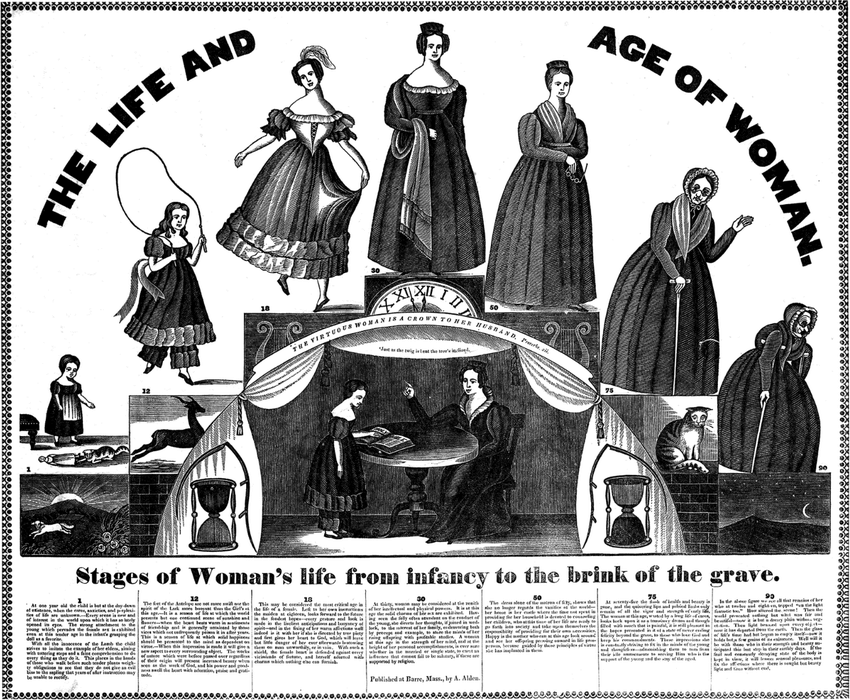
I have written several times about Dante’s parabola of life (for example see here), which posits a model wherein we are born and are on the upswing until we reach the “perfect age,” and then start on the downward slope.  Over my desk, I have a framed picture of an early American graphic on the “Stages of Woman’s Life from Infancy to the Brink of the Grave.”

The-life-and-age-of-woman-stages-of-womans-life-from-the-infancy-to-the-brink-of-the

As you can see, life was seen as an arch, as a kind of parabola, with ascension to an apex, and then a relentless decline.  Extension of the life span (although life expectancy has actually decreased lately) and joint replacements may have shifted the curve a little, but one way or other the body breaks down.

Recently I read a variation on this in a discussion of Ladislaus Boros by Cynthia Bourgeault in the introduction to The Mystery of Death. The discussion posited that there were two lines to life, the physical parabola that Dante was so taken with and a “second curve”:

While the trajectory of the first (outer) curve leads, after that initial expansiveness of youth, toward greater and greater physical limitation and confinement, the trajectory of the second curve, when given full rein, rises irreversibly toward ever-greater interior freedom, expressed in those qualities of self-knowledge, personal agency, and the capacity to live imaginatively and richly within one’s interiorities. [I quote Bourgeault because Boros’ prose is prohibitively dense.]

 Mystery of Death presents the argument that the increasing physical limitations we are under in old age actually contribute to wisdom and bring us face to face with the real aspects of the world in which we find ourselves.  This is Boros (speaking always in the masculine voice): “He [the elder] loses his illusions: he learns to face up to disorder, suffering and inevitable frustrations, to accept them, to conform himself to them, and yet, to achieve something of lasting value.”

Not all kinds of knowledge and creativity improve with age.  David Galenson’s book on age and art, Old Masters and Young Geniuses, divides artists into two groups: conceptual geniuses who do innovative work early, and experimentalists, whose best work is the product of the slow accretion of learning, experience, and reflection – all of which occur in the later years.  There is a place for both.  We tend, however, to privilege young geniuses and resist acknowledging the “slow accretion” of careful reflection over time.

There is the trope of the wise old man or woman, and yet how many of us believe in it?  How many of us equate “thinking old” with stagnation, nostalgia, or senility?  If we don’t believe that our experience and time for reflection give us something of value, then we might as well go skydiving and try to prove (futilely, I am afraid) that we are still on an upward trajectory in some respect. And if we are wiser, how do we share that wisdom?  I have written elsewhere (“Teach Your Children Well”) of the difficulty and heartbreak of trying to help the young avoid our mistakes.

Many of my stories are about old people recognizing things they have learned – or, more often, realizing what they had failed to learn in their earlier years.  Most of these realizations are “little” learnings; I am still working on the bigger ones.  For an example of the former, you might try “Needs of the Living Organism.” 

Wendell Berry and His Portrayal of the Elderly

I have written before about my penchant for works about old age written by the old, by those who have experienced it.  It is particularly interesting to compare a work about the old written by an author before he has entered that uncharted territory with a work completed in his own old age.  There are many authors whose writings spanned long lifetimes, but today I want to talk about Wendell Berry (now 88), and two of his best novels: The Memory Old Jack and Hannah Coulter.  Old Jack was written when Berry was 40 and concerns a character who is 92.  Hannah was published when the author was 70; the title character is 79.  Let me start by saying that they are both wonderful novels and fantastic reads.  Both novels will have you pining for times gone by, even though those times are depicted as challenging and tragic.  If you have never read Berry, these are good books to start with, but be sure you have in hand a genealogy of Berry’s Port William, Kentucky – there was one in Hannah Coulter, and I found it invaluable.  Hannah Coulter and Old Jack appear in each other’s novels; like Faulkner’s Yoknapatawpha or Robinson’s Gilead, Berry has created a place and a community of people (referred to as “the membership”) that you will want to visit again and again.

But, back to old age.  The title, The Memory of Old Jack, has a double meaning.  Berry tells the story of Jack’s last day on earth through the eyes and memories of those around him. Jack’s past life comes out through his own overwhelming memories, which can be prompted by the smell of an apple pie, the creak of an opening door, a touch on the shoulder.  Sometimes these memories and observations intersect; the people around him are also the subject of many of his recollections.  But mostly, Jack’s own memories take over his whole being, and the ones who love him can just watch:

Old Jack has become a worry to them…. They have all found him at the various stations of his rounds, just standing, as poignantly vacant as an empty house.  And they have watched him, those who care about him, because they feel that he is going away from them, going into the past that holds nearly all of them.

And going into the past he is, seeing from a distance all that he could hardly comprehend when he was living it.  Like Sackville-West’s Lady Slane, “all passion is spent” and he is using his extreme old age to reflect on his past, something the elderly Lady Slane characterizes as “life’s last supreme luxury.”  Ah.

While Hannah Coulter also reflects on her life, it is in a more conscious manner.  The book opens with her memories of her dead husband’s memories (now alive only in her recollection of what he told her) and with her own story, told as she lives out an active life in the community that took her in and nurtured her when she was a young and lonely girl.  We get the past more consciously than we get it in Old Jack.  Berry is no longer writing of a sleepy, stationary oldster – Hannah is still living her life, as she takes time to reflect on her past: “Like a lot of old people that I have known, I am now living in two places: the place as it was and the place as it is.”  And place is critical.  “By those who have moved away, as my children have done, the dead may be easily forgotten.  But to those who remain, the place is forever a reminder.”  Jack is seen from a distance by a younger Berry; Hannah is perhaps the kind of old person Berry is or wishes to be.

Both Hannah and Jack are also preoccupied with their legacy – not in money or reputation, but in the stewardship of the land they tended for so long.  It is heart-breaking to both of them that their children did not return to the land.  Hannah’s children understand her attachment to the farm, but they know what farm life is and have made other choices.  Jack’s only child does not even understand.  Hannah thinks about leaving her land in some kind of conservancy; Jack tries to arrange for a young couple who have been renting his farm to buy it after his passing.

The two novels are different in many ways.  Old Jack is a figure of respect and care for the community.  He is on his last legs.  People round him up for meals and give him rides when they meet him on the road.  Hannah is still someone who is there to help.  She is a good elder in that she seldom offers unsolicited advice, but she is ready to help when people present themselves at her doorstep, as happens when she takes in a ne’er-do-well grandson.  Now, it is true that Hannah (79) is younger than Jack (92), but it seems that Berry has moved from musing on care for the elderly (in Old Jack) to the care and wisdom that the elderly are able to give to their community.

In an even later Berry novel, the title character, Andy Catlett, remembers his grandfather sitting empty-handed in a rocking chair and “studying” every night in front of the fire.  From a perspective of years later, the older Andy says that he had no idea at the time as to what the old man was “studying,” but “now I have aged into knowledge of what he was thinking about.”

This blog (When I Come to Be Old) is titled after a series of admonitions that Jonathan Swift wrote to himself about old age, when he was but thirty-two.  He promises himself not “to tell the same story over and over to the same People,” “not to talk much or of myself,” “not to boast of my former … favor with the ladies,” and so on.   The list is lively enough to show that Swift has given the matter some thought; it also shows a lack of sympathy with the elderly around him.  He is wise enough to end it: “Not to set up for observing all these Rules; for fear I should observe none.”  Old age is another world; Swift calls the state of extreme old age as being as a “foreigner in his own country.”  By the time that Berry has reached that stage, he is giving his older characters more depth, more autonomy.   Or so it would seem.  Both books are highly recommended.

This week’s story, “Skillful Means,” is about the distance between intention and reality.  It was written (partially) out of my own memory and my own good intentions.

Old Folks and Tales of Climate Catastrophe

We watched Don’t Look Up last night, which led to some interesting discussions and dreams (nightmares?) at our house.  The movie would seem to be an allegory for the way the world is (or mostly isn’t) dealing with climate change.  Old characters – other than a pathetic old general who runs an abortive mission to save the world – do not have much of a role, but the movie got me thinking about some recent novels about our future and climate change in which the old are integral to the plot.

The character of old Grandy in High House by Jessie Greengrass is a good example.  Grandy is raising his granddaughter in a summer community; Grandy takes care of everyone’s cottages while they are away, knowing how to do almost everything from repairs to gardening. The climate scientist in the book seeks him out because she has a “high house” nearby – a house presumably safe for a while from storms and ocean elevation – and is preparing the property to harbor her young son and teenage stepdaughter when the apocalypse comes.   The scientist knows the house will eventually be surrounded by water, so the huge stockpiles she has amassed will (hopefully) not be stolen or plundered.  The scientist herself intends to stay in the battle until the end; she does not foresee herself surviving to get to the high house.  Close to the beginning of the major devastation, she convinces Grandy, now in a wheelchair from a broken hip, to move into the high house with his granddaughter and help her children survive.  Grandy complies; his house will flood. He has no choice.

So we are left with a high house, two teenage girls, a very young boy, and Grandy – who cannot do much but knows everything about how to get the generator going, feed the chickens, harvest the garden, thresh the wheat.   Grandy is the fountain of both wisdom and knowledge.  He delivers instructions patiently from a chair in the kitchen, as the younger folks tend livestock, plant vegetables, and salt fish.   At first their isolation and wholesome lifestyle at the high house seems idyllic, and then the generator stops working, the storms get worse, and the full impact hits.  It ends with the thoughts of one of the young women.  Caro says “the high house isn’t an ark.  We aren’t really saved.  We are only the last ones, waiting.”  There is no doubt, though, that they would not have lived as long as they had without Grandy.  There is also no doubt that had the world had Grandy’s wisdom, the predicament might have been averted.  I highly recommend The High House.

I do not recommend Joy Williams’ HarrowFirst is a hard book to read – although this in itself is not a reason to avoid it.  Sometimes hard books are needed to address hard topics – but not in this case.  The Atlantic calls Williams “the great prophet of nothingness.” Harrow gives us no such redeeming characters or situations as we have with Grandy and his charges at the high house.  We sometimes empathize, but we do not identify with these people, nor do we admire them.  The main character (Christen, nicknamed Lamb), in a search for her lost mother in a time of civil dissolution and “conservative” politics (meaning in this case actually waging war on what remains of nature), stumbles on a dilapidated resort/conference center full of old people who are, by turns, giving up their lives in what seem to be futile acts of ecoterrorism.  They cannot bear to live without doing something, but there is almost nothing they can do but die with great futility.  They fail to even comfort each other, and their acts of self-immolation are often misdirected.  If Grandy tried to help with his old-fashioned knowledge about how to live a primitive life, these folks are just trying to figure out the best way to die.

These two novels are climate dystopias, but they somehow reminded me of Margaret Drabble’s much more conventional book of a few years ago about ways to be old, The Dark Flood Rises.  Drabble’s book (highly recommended) touches on climate change only incidentally, with the main character being an older woman, Fran, who works on housing issues for the elderly, cares for her ailing ex-husband, and tries to make some sense out of what remains of her life.  Most of the other characters are also old, and we get an array of ways people arrange the ends of their lives – physically (much discussion of old age homes and such) and psychologically.

“Prepare your ship of death” Fran tells herself over and over – which is a phrase from “The Ship of Death” by D.H. Lawrence from whence Drabble got the book’s title:

Piecemeal the body dies, and the timid soul

has her footing washed away, as the dark flood rises.

Lawrence is talking about the “dark flood” of death; these books enable us to also read it as the dark flood of global warming.

I have written about old folks and environmental issues before (see “Failing Bodies and the Failing Planet“).  Our role is an open question that these books address – do we have wisdom to offer?  Should we risk death (so close anyway) to help in some way?  What to do? 

This week’s story, “Three Women,” does not seek to answer these questions, but just to look at some ways we pattern our lives and see (or fail to see) ourselves.


Lost Horizon and the Purpose of (Extreme) Old Age


Most of you have probably read James Hilton’s Lost Horizon at some point in your life.  A good read if there ever was one.  As you might remember, it involves the hidden land of Shangri-La (which is where we get this word from), deep in the mountains of Tibet.  Four unwitting passengers crash land in a small plane near the lamasery, and we are told the story by someone who met up with one of those passengers years later.  The narration style is much like that of Heart of Darkness, but the story is even stranger.

The lamas at the monastery oversee a “happy valley” which is protected enough from the winds and weather for abundant farming and living in the kind of moderation believed in by the lamas, one of whom explains to their visitors: 

If I were to put it into a very few words, my dear sir, I should say that our prevalent belief is in moderation.  We inculcate the virtue of avoiding excess of all lands – even including, if you will pardon the paradox, excess of virtue itself….We rule with moderate strictness, and in return we are satisfied with moderate obedience.  And I think we can claim that our people are moderately chaste, and moderately honest. (50)

The lamas themselves have less moderation and more discipline and have learned how to age to wondrous numbers of years, living for centuries (but they are not immortal).  As the head lama tries to entice Conway, the main character, to stay and undertake their way of life, Conway  questions the purpose of such a long life:

…your sketch of the future interests me only in an abstract sense.  I can’t look so far ahead.  I should certainly be sorry if I had to leave Shangri-La tomorrow or next week, or perhaps even next year; but how I shall feel about it if I live to be a hundred isn’t a matter to prophesy.  I can face it, like any other future, but in order to make me keen it must have a point.  I’ve sometimes doubted whether life itself has any; and if not, long life must be even more pointless.(108)

And then the old lama tries to answer him:

There is a reason, and a very definite one indeed.  It is the whole reason for this colony of chance-sought strangers living beyond their years.  We do not follow an idle experiment, a mere whimsy.  We have a dream and a vision… it seemed to him [the founder] that  all the loveliest things were transient and perishable, and that war, lust, and brutality might someday crush them until there were no more left in the world…he saw the nations strengthening, not in wisdom, but in vulgar passions and the will to destroy; he saw their machine power multiplying until a single-weaponed man might have matched a whole army…. when they had filled the land and sea with ruin, they would take to the air…. Can you say that his vision was untrue? (109)

And then he goes on to envisage how Shangri-La will be left, hoped to be spared, when civilization destroyed itself:

We may expect no mercy, but we may faintly hope for neglect.  Here we shall stay with our books and our music and our meditations, conserving the frail elegances of a dying age, and seek such wisdom as men will need when their passions are all spent.  We have a heritage to cherish and bequeath.  Let us take what pleasure we may until that day comes… when the strong have devoured each other, the Christian ethic may at last be fulfilled, and the meek shall inherit the earth.   (110)

I post these long quotes because they raise questions that interest me.  What is the point of extreme old age and what would we be willing to sacrifice to get it? In any case, I think it is worthwhile to think about why we are watching our diets, slogging to the gym, taking statins, replacing joints.  To live longer, yes.  Out of fear of dying, of course.  But what are we doing with all those additional years?  Are we like the inhabitants of Shangri-La, just trying to preserve a way of living?

And is there any purpose in trying to preserve a way of life that is not just fading, but disappearing at a rapid rate?  The lama sees a hope that as civilization destroys itself, Shangri-La will preserve the “elegances of a dying age.”  Is that the purpose for extreme old age?  I do enjoy “the elegances of a dying age.”  Some I can hang onto – old books and movies, classical music, setting a nice table for dinner.  Some I have no choice but to watch dissolve around me.  For example, rampant development has made it very hard for me to go back to some of the scenes of my youth.  And I have long since given up on any hope that these “elegances” will be passed down to the next generation – who are living very different lives and have no interest in my china or acoustic piano.

There are, of course, many other reasons to want to live a long life.  It might be worthwhile, however, to try to verbalize them and use them as a map if we are lucky enough to live a long life.  St. Benedict thought he knew the purpose of old age; “our life span has been lengthened by way of a truce [with God], that we may amend our misdeeds.”  Simone de Beauvoir thought that we had to create a purpose, a project, for ourselves to make old age worthwhile. “There is only one solution if old age is not to be an absurd parody of our former life, and that is to go on pursuing ends that give our existence a meaning.”  With so many of us living longer, it is a topic worth pondering, no?  And you might re-read Lost Horizon while you are thinking about it.  Or look at a previous blog I wrote about the purpose of old age.

 Shangri-la is a kind of utopia; it also portrays a form of gerontocracy – governing by the old.  I have never written a utopia, but I once wrote a speculative novel about a gerontocracy – the Prelude of which is here.  Oddly enough, although written many years ago, it starts with a pandemic virus. 

Vollendungsroman, Again and “Olive, Again”

A while back, I wrote about the Vollendungsroman, a term for a novel about the “winding down” of life. It is the counterpoint to the Bildungsroman, a “coming-of-age” story about young people approaching adulthood. There are thousands and thousands of the latter, and as young people, we lapped them up – trying to figure out what life was about, what we were supposed to think, to do. They came in all varieties – from Little Women to Catcher in the Rye. We read them all and we read them for at least two reasons: 1) because we wanted to know how to live our lives, and 2) they made us realize that we were not alone in our human predicament. As we age, those two needs have not gone away.

It is important to me to think consciously about what old age means, how it should be considered, lived. Many of us did not consciously grow into adulthood – we did it messily and often badly; there were repercussions because our dayspring was mishandled. We made the mistakes of youth and sometimes we kept making them even as we left youth behind us. Marriage, parenthood, middle-age often found us too busy to be conscious of anything – our lists were short-term, by psychic necessity. Some of us did plan financially for retirement, but not, perhaps, in any other way. And now we are old. Yes, we are. Call it what you will. I have time now to age consciously. And I look to literature to help me. Philosophy, science, and psychology are good too, but literature about old age allows me peer into the possibilities rather then the probabilities and the logic of it all. And particularly to see how people grapple with their pasts.

For the Bildungsroman is about the life of our origins, of what we were born into – and usually about the process of breaking away. But the novel of old age, the Vollendungsroman, is often about reconciling with our own pasts – the mistakes, the errors, the patterns, that we made along the way. This may include some debris from our family of origin, of course – that business is never over. But mainly it is about the life we have lived, the children we have engendered, the people we have loved, the people we have hurt. Some of it is to be valued, some left behind, some used as a lesson.

I just finished Elizabeth Strout’s wonderful new book Olive, Again. Definitely an example of the Vollendungsroman. The novel reminds me a little of Sherwood Anderson’s Winesburg, Ohio, but set in the world of the elderly. Olive is the central character, but there is also a wide range of people, of family stories. In Strout’s My Name is Lucy Barton, the writer/character says of another writer: “And she said that her job as a writer of fiction was to report on the human condition, to tell us who we are and what we think and what we do.” And this is what Elizabeth Strout does – she writes about the human condition and lets us know that 1) we are not alone, 2) it is never easy, and 3) there can be great dignity in it. And Strout knows that aging with dignity is not about acting as young as possible. In the words of one of Strout’s characters, “our job – maybe even our duty – is to bear the burden of the mystery with as much grace as we can.”
Amen to that: with as much grace as we can.

Olive is old when the book begins and very old by the end. We watch her get used to widowhood, struggle with an imperfect relationship with her son and his family, and slide into a second marriage and second widowhood. She finishes in a kind of assisted living center where she is typing on an electric typewriter (her choice and supplied by her son) because her computer and its printer had made her “so frustrated she shook.” (Yes.) Olive is typing up memories, trying to make sense out of the past. In the last chapter, we find Olive marveling at the new buds on a rosebush and contemplating her own impending death; in this juxtaposition “the sense of wonder and trepidation returned to her.” She sits down and writes these two sentences:

I do not have a clue who I have been. Truthfully, I do not understand a thing.

Yes. Not many of us can be that truthful. But we can read about people who are (Olive is often truthful to the point of offensiveness), and consider what it is we really think, what we believe, and how we should act on those beliefs.

Elsewhere, I have provided some lists of readings on old age, including novels, essays, poetry. Today’s story, “Last Things,” is about one woman’s approach to getting old. As might be obvious, I try to figure out how to age not only by reading, but also by writing. In any case, enjoy.

The Poetry of Old Age

On the topic of aging, I most trust poets who are old. Some poets –like Frost and Yeats – wrote poetry throughout a long life. Some turned to poetry in their old age. Thomas Hardy published his first volume of poetry at age fifty-eight and apparently wrote nothing but poetry for the next thirty years. I think poetry lends itself to the old mind, both in the writing and the reading. Good spirits must be distilled.

There are various types of poetry about old age. There is serious poetry and silly poetry. There are elegies for what has been and odes to the joys of senescence. There are genres and tropes. There have been more than a few poems about glimpsing one’s own aging façade in the bathroom mirror – one thinks of Hardy’s “I Look Into My Glass” or Robert Graves’ “The Face in the Mirror.” There are poems of return to places of one’s youth and reminiscences of lost loves. (Yeats is good at this.) Poignant poems capture the difficulties and loneliness of old age. There are no more affecting lines than the end of Frost’s “An Old Man’s Winter Night.” Other poems are filled with the realization that life is going to go on without us, as in Housman’s “Tell Me Not Here.

Then there are the losses – which some poets see as a mixed blessing. There is the loss of memory. In “The Winter Palace,” Larkin writes that “Some people know more as they get older, /I give all that the cold shoulder.” There is the loss of those we love, as in  Auden’s “Funeral Blues.” And the prospect of our own death, which for some is fearsome (mostly for the younger ones – Dylan Thomas was only thirty-three when he wrote “Do Not Gentle”), for others is welcome (Stevie Smith’s magnificent “Black March” or Auden’s “A Lullaby”). For some the final event is imagined – we hear and see the deathbed scene in Dickinson’s “I Heard A Fly Buzz When I Died.”

As I read poetry or novels, I note the age of the poet/author at the time of composition. This is easier in older volumes wherein the date of birth of the author appear on the back of the title page in the Library of Congress information (why did they stop?), but there is always Wikipedia. I find it particularly interesting to read works of poets at about my own age. The human experience is not entirely singular; there are correspondences. And differences.

I read poetry about old age to learn about myself. Poets can put into language what I often cannot. If I cannot speak it, if I cannot even think it coherently, I cannot truly comprehend it. E.M. Forster asked, “How can I know what I think until I see what I say?” Flannery O’Connor said, ““I write because I don’t know what I think until I read what I say.” I read poetry about old age to give me words for what I am feeling. To give me courage. And sometimes for comfort.

I have attached a list in progress of some poems about aging that are worth looking at. In addition, as I have noted before, there is a wonderful collection by Harold Bloom entitled: Till I End My Song: A Gathering of Last Poems. There is also The Art of Growing Older by Wayne Boothe which gathers poems and other literature about aging into categories. Part of my daily reading for years has been in the Poem A Day books – there are three volumes. The original volume was compiled as a project for The Natural Death Centre in Great Britain, and many of the poems address old age, loss, and death. Many of them also express and bring joy. I will add to my list of old age poems as more come to mind or are discovered; I encourage readers to send me their own favorites. In this business of being on the downside of life’s parabola, we all need comfort, companionship, and a marked-up map.

So what is my favorite poem about aging? I am tempted to cite Frost’s two-liner, written in his eighties:

Forgive, O Lord, my little jokes on Thee
And I’ll forgive Thy great big one on me.

But no. My choice (at least for today) is from A. E. Housman’s volume Last Poems. Housman published only two volumes of poetry in his lifetime – one at age thirty-seven (A Shropshire Lad) and Last Poems at age sixty-three. I own a first U.S. edition of the latter, and it is a treasured possession. On page 60 is the following poem:

XXXV
When first my way to fair I took
Few pence in purse had I,
And long I used to stand and look
At things I could not buy.

Now times are altered: if I care
To buy a thing, I can;
The pence are here and here’s the fair,
But where’s the lost young man?

– To think that two and two are four
And neither five nor three
The heart of man has long been sore
And long ’tis like to be.

If you are interested in poems about old age, you might also look at my post about last poems here.

Notes on Faust

I just came back from visiting my mother in Memory Care. A few days spending time with patients in various stages of health and dementia has gotten me thinking about Faust again – about the Faust legend in general terms and what kind of Faustian bargain we might have made and be making for the miracles of life extension.

Spengler called Faust the fundamental myth of Western Civilization and this myth has been tackled by great authors from Marlowe to Goethe to Mann to Bulgakov. In case you have forgotten, Faust is a scholar who sells his soul to the devil in return for knowledge, power, wealth. Faust supposedly traces back to an historical figure in early 16th century in Germany, and was kept alive because it struck a deep chord in those who heard it or read it – in farcical plays, in fireside tales, or in early chapbooks.

“Not enough Fausts are written. Everyone should write one,” said Ludwig von Arnim in the early 19th century. In fact, we all write one with our lives. For what are we willing to sell our souls? I, in fact, wrote a “Faust” novel a few years back (the prologue to A Kind of Joy or An Essay with Characters is here), and the exercise forced me to think about this question and how other authors have dealt with it. Marlowe’s Faust asked for magic, Mann’s wants to create great musical compositions, and Goethe’s wants never to be bored. The Faust I created was a woman, and she wants the opposite of what Goethe’s Faust wanted – my fictional Faye wants contentment, peace. For that she is willing to sell her soul. But that is a story, a thought experiment.

If the Faust legend is the central myth of Western culture, of the Enlightenment, then what has our culture bargained for? Like Goethe’s hero, we surely don’t want to be bored; one might wonder what we have sold our attention for. And we don’t want to die. In most of the Faust stories, the protagonist gets twenty-four years before the soul must be handed over. But twenty-first century people do not want to die at all, and has continually increased life spans until our bodies often last much longer than our minds. Science may solve this problem, but don’t count on it. And thus we keep building “Memory Care” facilities to house our bodies, and we keep uploading our pictures and memories to the cloud to ensure that they are not lost forever. I don’t have an answer. Science has done wonders in eradicating disease (think of polio vaccine!), disability (think of cataract surgery!), and the debilitations of old age (think of hip replacement!). It has also made many deadly diseases into simply chronic ones (think of insulin!). But it has not yet enabled our minds to function as long and well as our bodies do.

In the end, most fictional Fausts learn their lesson. Sometimes they lose their lives and souls (Marlowe) and sometimes they recant and the author rescues them at the last moment (Goethe). It doesn’t really matter. The important point is to consider what we sacrifice in life for what we receive. It is easier to think about the rewards and not the payment, but there is that unavoidable moment when payment comes due (Goethe notwithstanding). My mother has lived far longer than her parents or grandparents, but finds herself in a mental state that they never had to experience. Our planet has afforded most of us in the West lives of comfort and plenty, but now our seas are rising and our summers are stifling. Faustian bargains are traditionally with the Devil, but perhaps we could think of the Devil as representing our more impulsive nature, of the tendency to favor immediate gratification over the long-term good. In any case, it is an interesting problem to think about.

Faust might be an especially good legend to contemplate in our old age. In Goethe’s version, it is the old mythological couple, Baucis and Philemon, who stand up to the land-developing, greedy Faust. They refuse to sell out and move from the remote bungalow and thus anger Faust: “Their stubbornness, their opposition/ Ruins my finest acquisition.” Needless to say, they lose (and die), but they will forever stand on the moral ground. In the remoteness of old age – past the time of ambition and acquisition – maybe we can see the ramifications of the Faust myth more clearly  than our children. It is worth thinking about. What did you sell your soul for? What would you sell your soul for?