Baby New Year and Old Father Time

Happy New Year! The time of year prompted me to consider the image we have of an old man for the old year and a baby for the new year. The old man of the lapsing year often is conflated with the “grim reaper,” making him more than a little threatening. But generally, the ancient one (and he has gotten so old in only one year!) is just handing off a lantern or an hour glass to the babe with the admonition, perhaps, to make the most of the new life, the new year. As the light gets stronger and the days get longer, everything seems to renew. Soon the sap will be rising.

And we are swept up in it in this rebirth of the year. All us old people are making resolutions, showing up at the gym (this is always the most crowded time of year for exercise facilities and doubtless good intentions are very profitable), going on a diet, enrolling in a conversational Spanish class or some other vehicle of self-improvement, and yet – we are still old. The year is new, but we still need that cataract surgery, our arthritis still aches. Nature recycles through the seasons, but as individuals we – get old. The media tells us today is the first day of the rest of our life (and this is surely true enough), and yet we enter into it with the old body, the baggage of memory, and the parameters of circumstance. None of that changes as the year rolls over and the old man hands the lantern to a baby new year.

We want it to be otherwise. Psalm 103 tells the faithful that “[the Lord] satisfies you with good as long as you live, so that your youth is renewed like the eagle’s.” As in the image of the new baby and the old year above, I got to thinking about what this promise really meant. The eagle appears approximately 34 times in the Bible and is often associated with renewing strength. One remembers the emotional passage from Chariots of Fire, when the Olympic runner Eric Liddell, who refused to run on Sunday, reads to his audience from Isaiah 40: “But they that wait upon the LORD shall renew their strength; they shall mount up with wings as eagles; they shall run, and not be weary; and they shall walk, and not faint.”

Apparently the eagle was thought to actually be able to renew itself; the persistent legend is that at about age 50, the eagle can make a decision to fly to a special mountain where its beak, talons and feathers renew themselves after about 5 months. Certainly a five month hiatus for most fifty-year-old humans would renew some of us, so maybe we can take something from that. But the eagle thus allegedly garners another 10-20 years of life. Birders and scientists say the legend is not true, but eagles do often go through a severe molting at about five years and can look pretty scruffy for a while – until their new feathers come in and they are “renewed.” Many think that is the source of the legend. In any case, there it sits in the Bible to inspire us to a new birth, to renewal.

None of this is new. Man from time immemorial has complained that Nature renews itself in ways that the individual man cannot. (I know, I know, the scientists are working on it!). Hopkins complained on a spring day that:

See, banks and brakes
Now leavèd how thick! lacèd they are again
With fretty chervil, look, and fresh wind shakes
Them; birds build—but not I build; no, but strain,
Time’s eunuch, and not breed one work that wakes.

We get reprieves. Good doctors replace our hips, we recover from illness; good fortune gives us a better day now and then. But our bodies are not a renewable resource in the long run. (A lesson often learned too late, as some of what we suffer in old age is the result of youthful mismanagement of this precious resource.) Hopkins ends his poem with a plea for renewal of another sort. “Send my roots rain” he pleads.

In an earlier post, I wrote about “Second Growth,” quoting from Emerson’s journal about Thoreau’s observations that “men may have two growths like pear trees.” But the growth in pear trees is physical; any second (or third) growth human beings have has to be mental, spiritual. And this growth is within the old body; with this dichotomy there must be some sort of conciliation.

This is also the season of Epiphany. (See my story by that title in this month’s fiction. It is a little sentimental, but it is a Christmas story, after all.) In depictions of adoration of the magi, artists from Fra Angelico to Rubens often portrayed the wise men as of different ages: young, middle-aged and old. According to the apocryphal legends, the oldest was Melchior, Balthazar was in the middle, and the youngest magus was Caspar. Apparently, epiphanies are possible at any age.

Perhaps the best we can do is to follow the advice of Andre Gide: “Know that joy is rarer, more difficult, and more beautiful than sadness. Once you make this all-important discovery, you must embrace joy as a moral obligation.”  Perhaps the reconciliation of body and soul involves the willingness to accept the moral obligation of joy, even in diminished circumstances. Meanwhile we, with Hopkins, pray for sustenance for our roots.
Becoming and De-becoming

As I mentioned in my last post, I have been hobbled with a broken foot. I was carrying on quite well (perhaps too well) until I went to what I thought would be my last appointment with the orthopedist – looking forward to leaving the office with my cumbersome boot under my arm and destined for the trash bin. Instead, I was told that my foot hadn’t healed; we would have to give it at least another month and see what was happening. I did not take it well.

It is true that I have osteoporosis. I take calcium, eat a ton of yogurt, and exercise regularly, but my genes and my age have caught up with me. My body is breaking down and taking longer to repair itself. Eventually, of course, it will be beyond repair (some might say that it has already gotten to that point). In the course of my daily meditation, I repeat the five recollections (Upajjhatthana Sutta), the second of which is “I have a body which is subject to aging and decay; I am not beyond aging and decay.” I have been repeating these words for years, but somehow I don’t seem to want to believe them. None of us does. And yet, none of us is beyond aging and decay.

I have referenced Hermann Hesse’s Hymn to Old Age before, and I recommend it heartily. There was a critical article about Hesse in a recent New Yorker – even the title was negative: “Herman Hesse’s Arrested Development.” Hesse did try to catch the soul of the young, and this review emphasizes such works as Demian and Siddhartha, but neglects The Glass Bead Game – or, more accurately, points to it only in that it includes young men living celibate lives in perpetual school. Unfair, I think. Hesse wrote prose and poetry into his old age; The Glass Bead Game (particularly cited when Hesse was awarded the Nobel Prize) was published when he was in his sixties and has much to say about being old and being young. The compendium of his words in and about old age which I reference above is a treasure.

In any case, Hesse has this to say about the process of “de-becoming” – a term I have come to appreciate:

For the task, desire and duty of youth is to become, and the task of the old man is to surrender himself or, as German mystics used to call it, ‘to de-become.’ One must first be a full person, a real personality, and one must have undergone the sufferings of this individualization before one can make the sacrifice of his personality.

And this, again, reminds me of Buddhism, where “becoming” is not always a good thing, while Nibbana or “extinction” of desire is indeed to be wished for. Bhikkhu Bodhi, a great Buddhist scholar and translator puts it like this:

In the end he must choose between the way that leads back into the world, to the round of becoming, and the way that leads out of the world, to Nibbana. And though this last course is extremely difficult and demanding, the voice of the Buddha speaks words of assurance confirming that it can be done, that it lies within man’s power to overcome all barriers and to triumph even over death itself.

Like it or not, as we age we are “de-becoming” what we used to be – body and mind. It is a sacrifice that we make whether we do so willingly or not. But perhaps the measure of a Hesse’s “full person” is that one can surrender willingly, even joyfully. I have not gotten there yet, but the forces of nature are working on me.

This week’s piece of fiction (“May 12, 2036”) is an exercise based on Jorge Borges’ short story “August 25, 1983,” wherein the great Argentinian writer imagines meeting himself in the future on his own deathbed. (He died in 1986, so was off by three years.) It is an intriguing story and a good model. Read my story if you like, but please do read the Borges. And try the exercise yourself.

Narratives of Old Age

Are real people fictions? We mostly understand ourselves through an endless series of stories told to ourselves by ourselves and others. The so-called facts of our individual worlds are highly coloured and arbitrary, facts that fit whatever fiction we have chosen to believe in. It is necessary to have a story, an alibi that gets us through the day, but what happens when the story becomes a scripture? When we can no longer recognise anything outside our own reality? – from Jeannette Winterson’s Art Objects

Jeannette Winterson correctly points out that it is necessary to “have a story, an alibi that gets us through the day.” We all have narratives that we tell ourselves, for which we provide mental commentary as we move through our days. But what happens when our stories veer from reality? What happens when they become “scripture” for our consciousness, leaving no room for change or adaptation? And what happens when we get old?

What kind of story do we tell ourselves about getting old – if we tell ourselves that story at all? We tell ourselves stories about other people getting old, but we think we are all somehow… exceptions. My mother thinks she is the only person who is not “old” in her memory care facility. “This place is full of old people” she sneers with disdain as she shuffles past her peers down the long corridors. People put off going into retirement villages, elderly housing, assisted living, because those people are so old. And we say it with the same sneer that my demented mother uses. No young people ever complain about going away to college because the people are so young. (Although would you want to move into a dorm again with a gaggle of eighteen-year-olds?)

It is of great note that people of a certain age always claim to feel like they are younger than they are. A favorite conversation topic is divulging with our peers what age we feel like inside – 20? 15? 35? Surely not our real age – not 67 or 75 or 82. We think there is something wrong with our skin, our bones, our hearing because it is not what it used to be and because it does not match our mental image of ourselves. Sometimes I wonder if there is an acceptable story about getting old.

Jeannette Winterson says that we understand each other through “an endless series of stories told to ourselves by ourselves and others.” In our culture, the stories of old age we absorb from others are mostly stories of denial or hostility. “You’re only as old as you feel.” “Do not go gentle into that good night.” But here we sit with our old bodies and our minds that sometimes can’t remember the name of that woman across the street.

Virginia Woolf (who never got very old herself) demands an acknowledgment of the “great wars which the body wages with the mind.”  Woolf concedes that such honesty will not be easy: “To look these things squarely in the face would need the courage of a lion tamer; a robust philosophy; a reason rooted in the bowels of the earth.” Woolf also acknowledges that age itself changes our perception of the entire world: “If you are young, the future lies upon the present, like a piece of glass, making it tremble and quiver. If you are old, the past lies upon the present, like a thick glass, making it waver, distorting it.” Is age itself distorting our ability to tell ourselves a real story, a meaningful story?

What would a true and helpful story of old age be? Would a more reasonable narrative of the body’s weaknesses save us from the wasted energy of railing against every demonstration of those very debilities? (I am currently hobbling around in an orthopedic boot protecting a broken foot. It is temporary, but trying my patience and my story about being fit and active – but more on this next time.) If we could get past disdain, would we find some value in old age – a refuge, perhaps, from the competitions and expectations of our youth? Again, I ask all of us (old or young), what is our narrative of old age? And where did it come from? Other people? From our younger selves? Are we brave enough to tell a new story?

And while we are at it, we might also examine the story of the past. Old age is a time (and often has time) for reflection. Does our past match the story we were living at the time? There are still lessons to be learned.

This week’s story is “Playing by Ear,” about the stories we absorb through our auditory functions. Think about it.

Eden

Many dementia patients – including my mother – revert to the past. In my mother’s case, she escapes to a time before she had a husband or children. Experts in dementia say that age eighteen or nineteen is often where such patients end up. She looks for her parents, for houses and gardens she lived in long ago. Wonderful places. Gardens of Eden where she has no worries, where there is no shame or aging or death. And perhaps we are all looking for such a place. Perhaps we are all trying to return to Eden.

Before the era of progress, all of western culture looked back to Eden. Man had degenerated from the original Eden, from the original Golden Age. And so had the earth. Erosion of mountain peaks and the shortening of the life span from the amazing Biblical ages pointed to a world in the state of slow but continual degeneration. But then, somewhere along the line, we started to look forward rather than back as a civilization. The shift on the macro level, however, has not seemed to make a difference to the old demented person who is sure that her mother is waiting for her somewhere with a bowl of warm tapioca pudding.

Admit it. We all do a little of this backward-looking – we all remember Christmases that had a special glow or a magical childhood hiding place. We all, sometimes, want to return to Eden. But it can’t be done – or at least not easily. James Baldwin put it best:

Perhaps everybody has a garden of Eden. I don’t know; but they have scarcely seen their garden before they see the flaming sword. Then, perhaps, life only offers the choice of remembering the garden or forgetting it. Either, or: it takes strength to remember, it takes another kind of strength to forget, it takes a hero to do both – Giovanni’s Room.

In order to go back, one has to toss aside all that has been accumulated through the years. Renounce it. Religions say that this is one way to come to fulfillment:

The purpose of all valid spiritual disciplines, whatever the religion from which they spring, is to enable us to return to this native state of being – not after death but here and now, in unbroken awareness of the divinity within us and throughout creation… that state, is the Eden to which the long journey of spiritual seeking leads…. (E. Easwaren)

And some say that to grow up, we must leave Never-never Land behind us. In the old and confused, though, it is perhaps a safe haven. They go back to what doctors sometimes call a “reminiscence bump” from earlier life. Faced with physical and mental infirmity, the specter of death and the loss of a familiar world, these elders can go back in their minds to the haven of their youth. And perhaps we should be glad they can.

Where (and when) was your Eden? And have you tried to get it back through effort and acquisition (buying a house like the one you grew up in) or by renunciation? Have you forgotten it? Or are you one of Baldwin’s heroes who can acknowledge it and yet move on?

The story for this week (“Back to the Garden“) is not about elders, but it is about those who are facing the end and the garden where things start and things stop. It is also a tribute to Joni Mitchell and her exhortation in “Woodstock”: “We’ve got to get ourselves back to the garden.”

Parabola and Long Tails

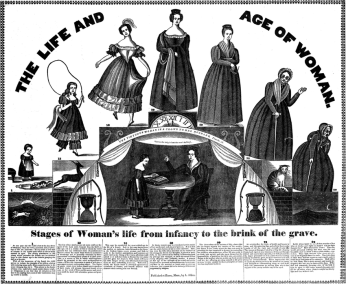
I wrote earlier in this blog about Dante’s vision of life as a parabola, which goes up to the “perfect age” (thirty-four according to Dante) and then starts down again. Life rises on one side and falls on the other, ending on the same level where it began. And so, as it falls, it passes through some of the same horizontal levels passed through on the way up – something that intrigues me, but which I will come back to.

If life for Dante was a parabola, I have wondered whether – seven centuries later – the shape of life has changed. Children (and mostly I mean well-off children) now seem to have a longer childhood. They stay at home longer, marry later, have children later. On the other side, old age is often very long indeed in the modern era. Medicine and technology have allowed life to be extended again and again, until the tail just lengthens and lengthens. Without judging whether this is a good thing or not, it surely changes the shape of a life. My mother, for example, has been old for a very long time. She has had multiple joint replacements and cancer surgeries, but is remarkably healthy as she approaches ninety – except that she has severe dementia. Scary dementia where she is sure that people are watching her, harming her, planning all manner of evil. And this could go on for a very long time. For better or for worse, old age seems to have developed what statisticians call a “long tail” – rather than dipping down precipitously at the end (think parabola), it tapers off as more and more is lost, and yet the heart goes on and so does some form of life. Where Dante saw the symmetry of a parabola, are we now seeing something else?

I like playing with the symmetry of Dante’s parabola. Over my desk hangs a nineteenth century depiction of the stages of a woman’s life – more an arc than a parabola but the idea is the same.

As I noted in my earlier post, the parabola gave me an idea for the structure of a novel which would pair points on the upward movement with corresponding points on the downward slope after the “perfect age” is reached. (Here is an interesting exercise – when did you reach your “perfect age”? Or aren’t you there yet? What is the difference between Dante’s perfect physical age and the perfect spiritual/mental age?) My novel is about two-thirds complete and will soon join its companions in my bottom drawer, but I thought I would post an excerpt. In order to illustrate and test my thesis that there are correspondences between the same point going up and coming down the life cycle, the novels pairs (fictional) diary/journal entries from the same woman, often on a common topic or theme.

The title of the novel is Hummingbird Wars and the excerpt includes two chapters/paired journal entries. In the this selection, we have a young mother being introduced to exciting new technology as the world opens up to VCR’s and personal computers in 1985. At the descending point on the parabola, the same woman in 2005 is nearing retirement, learning yet another version of the operating system at the office, and wondering about the true value of the internet, cell phones, and social media. If you are my age, you will recognize this woman (both the older and younger version) and her thoughts and concerns. If you are younger, you might wonder how your views of technology will change as you enter the long tail of old age.

Journaling in Old Age

Old man, old woman – it is not too late to start keeping a journal! I started to keep one conscientiously at age fifty-three, and I only wished I had done so earlier. These blogs are often an outgrowth of a journal entry, but the document, the content, is not my journal’s main value; it is the process of keeping a journal that is critical.

Like any good habit, keeping a journal is easy once you etch it into your life – scientific literature says this takes three weeks, but I would give it a few months. I started by disciplining myself (I know discipline is out of favor, but nothing worthwhile is ever done without at least a pinch of it!) to write a certain number of pages each month – ten single-space pages at font size 12. That has not changed. I often write more, but never less. And if I fall behind, I have to make it up by the last day of the month. In the early years, this often meant a lot of rubbish on the 31st! You do not have to write every day, but it’s easier to establish the habit if you do. I put in the date, skip a line, and proceed to discuss what I am reading, how I slept, what I am afraid of, surprised at, hopeless at figuring out. Give yourself lots of leeway. If all you can manage is a history of the day before or an agenda for the day ahead, so be it. Believe me, this will change!

You will find that having the journal to write slowly changes the way you view your life. You will catch yourself marking passages in books to transcribe (a journal works as a wonderful commonplace book) or trying to note exactly what someone says to you (pay attention!) so that you can record it in your journal as accurately as possible. More importantly, you will be turning your life into a narrative – your narrative. Not a Facebook narrative. (Can those people really be so happy? No way. They are either deceptive or deluded, maybe both.) Not a blog. You are not writing to impress anyone (and you should decide up front that you will not share). You are writing to try to narrate your own life. Susan Sontag said that “in the journal I do not just express myself more openly than I could to any person; I create myself.” Take your only opportunity to tell your own story.

I’m in my fifteenth year of doing this. I wish I had always done it – how edifying it would be to be able to look back on how I felt about being a new mother (scared and overwhelmed), how I navigated divorce (scared and overwhelmed) and then remarried (happy and overwhelmed). But the feelings I just put in parentheses are remembered. And we only have to have someone send us an old photo of ourselves or compare reminiscences with our siblings to realize that memory isn’t always completely reliable.

And (with my parentheses) I have just described another benefit (they are endless). You can look back a few months or years and see what you were worried about, what you fretted over – and recognize that those things have just evaporated. They either never happened or were not half as bad as you feared. There is a life lesson. There are many such lessons that we cannot learn anywhere but from our own experience – and experience not reified in words is hard to recall, difficult to grasp, and susceptible to psychological manipulation.  And the “search” function in Word gives me the ability to ascertain when I had a root canal (and sometimes even to settle arguments).

The document itself is a mixed blessing. For instance, there is the problem of what to do with all of this sensitive material – especially as I get older. I am not sure I would even want people I loved to read my daily thoughts (once in a great while you get angry with almost everyone), or have to decide how to dispose of them. I print out the journal monthly for vague reasons that may have something to do with the strange satisfaction of seeing the record of my life turned into copy, hole-punched, and piled up in loose-leaf binders in the closet. But I do spend time thinking about the appropriate moment in my life for a bonfire. But again, these problems are outweighed by the advantages.

So, try it. I recommend it and so do many wonderful writers and thinkers. The product is valuable. Salman Rushdie cautioned us to “never forget that writing is as close as we get to keeping a hold on the thousand and one things — childhood, certainties, cities, doubts, dreams, instants, phrases, parents, loves — that go on slipping, like sand, through our fingers.” But it is really not the product that is the most important. It is the process. The daily exercise of trying to make sense of your own life. Is there a better way that you could spend your time?

I am not posting a story this week, but if you want a smile, try Rich Schram’s blog at funreadsbyrichschram.blogspot.com. I particularly recommend his “Sheetrock Ballet.”

Answers?

My generation spent our young adult years being fascinated by all the new technology cascading to the market. We knew television from our youth, but soon it was color television, then there were VCR’s and cable TV, video games, there were computers in the office and then computers at home – and then the internet and cell phones arrived! Scanners, digital pix, e-mail, social media, texting, news on demand, ipads, smart phones, search engines – all of this was a long way from the US Postal Service and the Encyclopedia Britannica. We were fascinated, seduced, enamored, and then we were… suspicious, and sometimes overwhelmed.

I remember the first time I was exposed to a spread sheet program (Lotus 123) and realized those ledgers and blue and red pencils could go out the window. But the initial joy was followed by the realization that the answers we got from the spread sheets were only as good as the data and formulas that we put into them. The word processors produced gorgeous copy – error-free with justified margins, but the content was if anything diminished by the speed with which it could be produced. We learned the acronym GIGO – Garbage In, Garbage Out. We found that we could reach anyone in the world from our cell phone or computer, but that there weren’t that many people we wanted to talk to. (Remember Thoreau? “We are in great haste to construct a magnetic telegraph from Maine to Texas; but Maine and Texas, it may be, have nothing important to communicate!”) Google answered our questions, but we weren’t at all sure what questions to ask. Maybe Picasso spoke for all of us when he stated that “Computers are useless. They only give you the answers.”

Of course, computers and rational people can answer what are called convergent problems – ones with definitive answers that are the same across time and individuals. How do you build a bicycle? How far is it to the sun? But what are the important questions? For you? For me: “What should I do? How should I live? And (as I got older): Why haven’t I figured this out before now?” Ah, but maybe the problem is a blind belief in rationality itself and that we (or our computers) can “figure it out.” The best literature is written about the big questions of life. I just finished Richard Powers wonderful Prisoner’s Dilemma (and see here for a description of the philosophical problem for which the novel is titled) and the question that Powers asks is “what, if anything, can one private citizen do to make the shared scenario less horrible?” This is a great question for our time. A good exercise in reading is to attempt to ascertain what questions the author is asking and what – if any – alternative answers are presented to these interrogations.

Questions and answers. For all the rationality of Socrates, he is surely better at questions than answers. And wisdom literature of the religious variety is not much for definitive answers. In the Bhagavad Gita, we open with Arjuna asking Krishna why he must engage in battle. Krishna tells Arjuna that it makes no difference, in the end friend and foe are the same, and that Krishna himself is both the sacrifice and the sacrificer. Try to figure that out rationally. Arjuna learns a level of acceptance – “You have dispelled my doubts and delusions and I understand through your grace,” says Arjuna finally. “My faith is firm now, and I will do your will.”

Job asks God three questions: “Why did I not die at birth, come forth from the womb and expire?” “How can a man be just before God?” and “If a man die, shall he live again?” As far as I can see, God never answers any of these questions. After trying to argue rationally with his friends and with God, poor Job comes to the same conclusion: “Therefore I have uttered what I did not understand, things too wonderful for me, which I did not know.” God also takes Job’s “friends” to task for thinking they had “figured things out” and for giving Job false information. These friends end up needing to make big sacrifices and have Job intercede for them to stay on the right side of the Big Guy. The Book of Job and the Bhagavad-Gita are stories of acceptance, not stories of answers.

Computers have both absolute rationality and answers; it might appear that both are, in many ways, useless. Like Job’s friends. Computers give us answers, but answers – especially easy answers – are something of which we should be very suspicious.

But the questions, the questions are important. How do we interrogate our own lives to avoid GIGO? What are your questions? Think about it. And when you decide on your questions, run them through Google for a laugh.

This week’s story, “Don’t Eat the Pink Ones,” has more mysteries than answers, but it is appropriate for the end of the blueberry season.

Forgiveness and Remorse

Forgiveness is different in old age. In the hurry of youth and middle age, we often either push forgiveness aside or bestow it hastily in order to get on with things. In our latter years, old resentments drift out of the silence, out of the memory that cannot remember the word for that thing over there, but can recall all unkindnesses in great detail – the ones we received as well as the ones we perpetrated. Often those we want to forgive (or seek forgiveness from) are not available; they have passed out of our orbit through time, through death, through dementia.

Old age is teaching me many things and one of them is that the human condition is universal. Sympathy is replaced by empathy. There is no time or heart left for enemies. We are all friends in our common human afflictions. And David Whyte says that friendship is all about forgiveness. He says it “is a mirror to presence and a testament to forgiveness. Friendship not only helps us see ourselves through another’s eyes, but can be sustained over the years only with someone who has repeatedly forgiven us for our trespasses as we must find it in ourselves to forgive them in turn.”

And then there is the issue of forgiving ourselves.

Yeats wrote a poem that is a dialogue between the Self and Soul. Unlike similar medieval dialogues, the Self gets the final word here and it is about forgiveness:

I am content to follow to its source
Every event in action or in thought;
Measure the lot; forgive myself the lot!
When such as I cast out remorse
So great a sweetness flows into the breast
We must laugh and we must sing,
We are blest by everything,
Everything we look upon is blest.

“Casting out remorse” is easier said than done, but the result, according to Yeats, is a recovery of the innocence of Eden. In his “We must laugh and we must sing, / We are blest by everything,” the old Irishman sounds almost like Blake. Heaven all around us! But can we “cast out remorse” without doing something about it? David Whyte refers to the section of the Lord’s Prayer that implies in order to beg forgiveness ourselves, we must forgive “those who trespass against us.” It is a package deal. Of course, often the hardest person to forgive is oneself. I know.

I also find myself contemplating the need to beg forgiveness from this earth that we have been blessed with, out of which our kind was spun and nurtured. How it and its creatures have been abused in my lifetime! How can we ever atone!

Isak Dinesen too references the Lord’s Prayer in her sad story of watching giraffes from her beloved Africa being shipped to Europe:

The giraffes turned their delicate heads from the one side to the other, as if they were surprised, which they might well be. They had not seen the sea before. They could only just have room to stand in the narrow case. The world had suddenly shrunk, changed and closed round them.

They could not know or imagine the degradation to which they were sailing. For they were proud and innocent creatures, gentle amblers of the great plains; they had not the least knowledge of captivity, cold, stench, smoke, and mange, nor of the terrible boredom in a world in which nothing is ever happening….

As to us, we shall have to find someone badly transgressing against us, before we can in decency ask the Giraffes to forgive us our transgressions against them.

The giraffes and the polar bears and the elm trees and the monarch butterflies. Who can we forgive that will reciprocate the forgiveness we need from the world we are destroying? These are not easy questions, but they are on my mind.

Yeats says he is “ content to follow to its source /Every event in action or in thought; /Measure the lot; forgive myself the lot!” Measure first. A good carpenter will tell you to measure twice. Maybe realization is enough, but I’m not sure. I think I rather feel, with Dinesen, that more is needed before we can “in decency” throw off all remorse.

This week’s story is “The Iscariot” and references the most infamous sinner of all and describes a woman who sometimes feels like she is running a close second. And, perhaps, a different way to look at remorse and redemption.

What Are the Old To Do?

The current political situation in the United States leaves many older Americans (but certainly not all – the majority of people over 50 voted for Trump)  in a quandary about what to do. I have thought about this carefully and there are a few points I would like to consider.

In many cases, old people have little to lose. We are often on fixed pensions of one type or another, we don’t have a job to take leave from if we go out to protest, we needn’t fear reprisals from colleagues. We have Social Security and Medicare (at least for now). On the other hand, we are not as vigorous as we once were and long marches start us thinking about where the restroom will be and whether we can go the distance. But, while we may not have physical strength, we do have bodies to put in the way and, perhaps, a certain sentimental public relations value in such matters. (What cop wants to be photographed grappling with a white-haired old lady?)

We are tired and also a little resentful. Where are the young people? I know some of them are out there, but I do not see the passion or the numbers I remember.  (And, yes, I realize my memory is not perfect and getting worse.) When we were young we were out in the thousands protesting against the Viet Nam war, for Civil Rights, for the ERA. Shouldn’t the banner be picked up by those coming along behind us who have the most to lose, since they will have to live longer with the results? Are we more upset than the younger people because they think it’s just a phase they’ll live through, and we fear it may be a phase we will never see the other side of?

And yet we must do something. I keep chanting to myself: We cannot leave with things in this state. Like the dying person who puts her household in order so her children won’t have to deal with the muddle, I cannot imagine retiring, dying, from a world that is in such a … mess.

I envy Simeon, the old man in the New Testament, who was ready to die once he saw the child Jesus and was convinced that everything was going to be fine. “Lord, now lettest thou thy servant depart in peace, according to thy word; for mine eyes have seen thy salvation.” Simeon was a fortunate man. I think of Leonard Cohen, who died the day before Trump was elected; when I heard the news of his passing I remember being grateful he never had to face the next day’s revelation. But I also I think of Sigmund Freud, who escaped Austria for England in 1938. Before he left Austria, he said, “What progress we are making. In the Middle Ages they would have burned me. Now, they are content with burning my books.” He was wrong; there was no progress. If he had stayed, they might well have burned him also. Freud died in 1939 while things were surely looking disastrous, but without learning the full extent of the horror. But how hard is it to leave the world in decline, perhaps worse than you found it? Think of the old folks who died in Hitler’s concentration camps long before the Allies pushed through.

Many of our parents and grandparents emigrated to this country for a better life for their children and grandchildren – and those children mostly had a far better life. Those immigrant parents saw their children graduate from school, get jobs, buy houses, do better than their forebears. I find myself grieving for the future of my grandchildren. I mourn for their rights, their environment, their humanity, for civility and justice. And for the immigrant parents at the border whose children may never have a chance for that better life.

So, what to do? Postcards, phone calls, donations to ACLU, Planned Parenthood, good candidates? Local rallies, posts on Facebook, family arguments? Remain polite and civil in the face of the crude, the impolite, the uncivil, the unfair? Please feel free to post your ideas here.

This week’s story (“Ritual“) is about the power of ritual to get us through. Like little children, old people know about the utility of ritual to comfort and soothe. But, we (perhaps) should be thinking a little harder about how to break out of it.  And do something.

Aging Deliberately

I have always been challenged by Thoreau’s ambition to live life intentionally, with purpose and awareness: “I wished to live deliberately, to front only the essential facts of life, and see if I could not learn what it had to teach, and not, when I came to die, discover that I had not lived.” To live life deliberately. It seems like such an obvious and worthwhile goal.

I first read Walden in college. By then, it was too late to live my childhood deliberately – and is that even possible? For most of us, choices as to how we lived were severely limited until we were emancipated from our families. Our diets, our activities, our free time were all greatly prescribed. And the nuclear family meant that we often were not even aware that other choices existed. Do you remember how shocked you were when you ate a meal or spent the night at a friend’s house and realized that people did things differently? At six years old, I visited a house where the children were allowed to operate the television by themselves! Who knew?

During adolescence and young adulthood, hormones and the drive for emancipation drove me, drove most of us. And then, quickly enough, I was driven by my career and children. And too busy to think about much else. How else does one get through those years but by ploughing ahead with blinders on? When I visit my children now and watch them cope with young children and jobs and all the juggling of such a life, I still couldn’t tell you how it’s done – except that, under the circumstances, one has to suspend doubt that one can do it.

It wasn’t until I was in my fifties that I really had time to pause and think about the shape of my life. There wasn’t much that I could do about the past (except make sure I was telling myself a truthful story – but more on that another time), but the future stood out as a time of … my own. Soon I would not have to work anymore, would not have to live in a given place or a prescribed way, would not have direct responsibility for anyone except my partner and myself. But didn’t Janice Joplin warn us: “Freedom’s just another word for nothin’ left to lose”? Freedom itself can lead to futility, despair.

Jeannette Winterson says that the “question, ‘How shall I live?’ is fierce.” It is perhaps the only question. For so much of our lives things seem out of our control, and in our latter years we are, of course, subject to the decay and disease of our bodies. And yet. Surely facing deterioration and death is among the things we can do deliberately, unless we are robbed of this ability by dementia (which is just one of the things that is heartbreaking about that condition).

Here is Montaigne in his essay “Experience”:

We are great fools. “He has passed his life in idleness,” say we: “I have done nothing today.” What? Have you not lived? That is not only the fundamental, but the most illustrious, of your occupations. “Had I been put to the management of great affairs, I should have made it seen what I could do.” “Have you known how to meditate and manage your life? You have performed the greatest work of all.” … Have you known how to regulate your conduct, you have done a great deal more than he who has composed books. Have you known how to take repose, you have done more than he who has taken empires and cities.

So as we retire, we might ask ourselves Montaigne’s implied question, “Have you known how to take repose?” and realize its importance. In his repose, Montaigne looked inward and wrote his essays.

Of course, not all courses are open to us. How we (or the vagaries of life) have prepared our bodies and minds for this last part of life is consequential. Lord Bolingbroke who was forced into retirement in 1735 at age 57, wrote a treatise on study and retirement.  He reminds us such study “would have been agreeable and easy if he had accustomed himself to it early, will be unpleasant and impracticable late: such men lose their intellectual powers for want of exerting them, and, having trifled away youth, are reduced to the necessity of trifling away age. It fares with the mind just as it does with the body.” Cicero expresses similar concerns about dayspring mishandled in his essay on old age. But within the limits of our bodies and minds and preparation, choices still must be made. Old age is different from youth; to ignore the opportunities and challenges it presents will lead us to senescence mishandled.

Carl Jung always insisted that the stages of life had different purposes. “We cannot live in the afternoon of life according to the programme of life’s morning; for what was great in the morning will be little at evening, and what in the morning was true will at evening have become a lie.” You can read Jung’s “Stages of Life” for his advice on how to spend your old age, but, hey, we’ve lived a long time. Maybe we can figure it out for ourselves. And then do it. Deliberately.

This week’s story, “Essentials,” is not about old age, but it is about the challenge we face at every stage of life – how to make life meaningful. How to live – within the parameters with which we are faced – with intensity and deliberation and good intent.