Thoughts on the New Year and Turning 70

There is much hope in the land for the New Year; 2020 will not be fondly remembered by most people. I do not have to detail the collective tragedy of this lost year.  On the positive and personal side, we were blessed with two healthy new grandsons this year, but have only seen them once. And, just as the vaccine is in our sights, Covid has surged.  It has even entered my immediate neighborhood for the first time.

I have written in another year about the images of the “old” year (Father Time) and the “Baby” New Year.  This is a holiday which will not let us forget time is passing.  As I get older, New Year’s Eves come faster and faster, and I go to bed earlier and earlier.  No bells at midnight for me.  And I am cognizant today that 2021 is the year in which I will turn 70.  Seventy seems old to me.  I am sure I will get used to my new decade (although my husband who is two years ahead of me says he hasn’t).  But the numerical marker is a bellwether, a harbinger of things to come.

The Bible tells us that seventy years is all we can expect of life.  Psalm 90 is quite explicit on this point:

The days of our years are threescore years and ten; and if by reason of strength they be fourscore years, yet is their strength labour and sorrow; for it is soon cut off, and we fly away.

Or in a more modern translation:

Seventy years is all we have—eighty years, if we are strong; yet all they bring us is trouble and sorrow; life is soon over, and we are gone.

One can argue that in Biblical times 70 was much older than it is now.  Maybe.  But I know there are many things about old age that have not changed, that cannot be easily “cured,”  including the simple truth of the wear and tear our bodies and minds have undergone for seven decades.

As anyone who has been reading these blogs will know, there has been much debate in recent years on what our attitude toward old age should be.  One of my favorite authors (both as the academic Carolyn Heilbrun and the mystery writer Amanda Cross) wrote The Last Gift of Time – Life Beyond 60It is a lovely book about getting older and delineates many of the joys of old age.  Yet, Dr. Heilbrun also vows in the book to commit suicide at age 70,  as “there is no joy in life past that point, only to experience the miserable endgame.”  She actually waited until she turned 77; I wish she had waited longer.

A few years back (2014), Ezekiel Emanuel (noted oncologist and bioethicist who was recently appointed to Biden’s Covid team and whose brothers are Rahm and Ari) wrote a much-discussed article in The Atlantic entitled “Why I Hope to Die at 75.”  The title is misleading; Emanuel does not necessarily hope to die in his mid-seventies.  But he has decided that by age 75 he will give up all measures to make him live into a very long but perhaps debilitated old age.  He is clearly against euthanasia and physician-assisted suicide, but:

I am talking about how long I want to live and the kind and amount of health care I will consent to after 75.  Americans seem to be obsessed with exercising, doing mental puzzles, consuming various juice and protein concoctions, sticking to strict diets, and popping vitamins and supplements, all in a valiant effort to cheat death and prolong life as long as possible.  This has become so pervasive that it now defines a cultural type: what I call the American immortal.

I recommend the article – particularly those parts about where our health care dollars are going and how statistics show that longevity improvements often just “increase the years spent in disability.”  By the way, Dr. Emanuel says in this essay that he will no longer take flu vaccines after age 75; I wonder how he feels about this in the current situation.  I do not want to make his argument simplistic though; it is a powerful statement of reality in the face of the very unreal chase after immortality.  As I approach my eighth decade, all these things are on my mind.

This is my last post in a remarkable year.  It is also the time for printing up my journal for the month of December and completing the three-ring binder labeled 2020.   This is the 17th year I have undertaken this process of recording my life in an organized way; these piles of words remember more than I do.    Virginia Woolf said, once, that she wrote her diary for her 50-year-old self to read (she was in her thirties when she said this).  Why does a 70-year-old keep a diary? (I bet you know the answer to this – if not read my blog on the subject here.)   And when is it time to stop writing and just to review and reflect?

December 31st  is also time to put away my books of morning readings – this year it was readings from C.S. Lewis and the third volume of a set of daily poems that I cycle through on a triennial basis. It is a time to start clearing away Christmas decorations and throwing out old calendars. 

And, as we clear away the old, are we getting ready for that final clearing away?  Does the end of a year make us consider that – perhaps – the new year might be our last?  Out with the old, in with the new?  Old man time being replaced by baby new year?  The old year being shuffled into drawers, shut into binders,  or collected in folders for our tax returns?  I have made no resolutions for the New Year.  I am not as pessimistic as Carolyn Heilbrun or Ezekiel Emanuel, but I did watch my mother’s life disintegrate into a malicious form of dementia in the end.  There should be some middle ground to this business of fading out, of becoming someone we don’t recognize mentally or physically.  I have no answers, but am open to alternatives.  And, in truth, I look forward to this new year.  Especially, to this new year.
 

Parabola and Long Tails

I wrote earlier in this blog about Dante’s vision of life as a parabola, which goes up to the “perfect age” (thirty-four according to Dante) and then starts down again. Life rises on one side and falls on the other, ending on the same level where it began. And so, as it falls, it passes through some of the same horizontal levels passed through on the way up – something that intrigues me, but which I will come back to.

If life for Dante was a parabola, I have wondered whether – seven centuries later – the shape of life has changed. Children (and mostly I mean well-off children) now seem to have a longer childhood. They stay at home longer, marry later, have children later. On the other side, old age is often very long indeed in the modern era. Medicine and technology have allowed life to be extended again and again, until the tail just lengthens and lengthens. Without judging whether this is a good thing or not, it surely changes the shape of a life. My mother, for example, has been old for a very long time. She has had multiple joint replacements and cancer surgeries, but is remarkably healthy as she approaches ninety – except that she has severe dementia. Scary dementia where she is sure that people are watching her, harming her, planning all manner of evil. And this could go on for a very long time. For better or for worse, old age seems to have developed what statisticians call a “long tail” – rather than dipping down precipitously at the end (think parabola), it tapers off as more and more is lost, and yet the heart goes on and so does some form of life. Where Dante saw the symmetry of a parabola, are we now seeing something else?

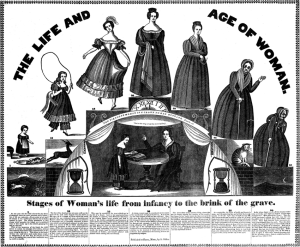
I like playing with the symmetry of Dante’s parabola. Over my desk hangs a nineteenth century depiction of the stages of a woman’s life – more an arc than a parabola but the idea is the same.

As I noted in my earlier post, the parabola gave me an idea for the structure of a novel which would pair points on the upward movement with corresponding points on the downward slope after the “perfect age” is reached. (Here is an interesting exercise – when did you reach your “perfect age”? Or aren’t you there yet? What is the difference between Dante’s perfect physical age and the perfect spiritual/mental age?) My novel is about two-thirds complete and will soon join its companions in my bottom drawer, but I thought I would post an excerpt. In order to illustrate and test my thesis that there are correspondences between the same point going up and coming down the life cycle, the novels pairs (fictional) diary/journal entries from the same woman, often on a common topic or theme.

The title of the novel is Hummingbird Wars and the excerpt includes two chapters/paired journal entries. In the this selection, we have a young mother being introduced to exciting new technology as the world opens up to VCR’s and personal computers in 1985. At the descending point on the parabola, the same woman in 2005 is nearing retirement, learning yet another version of the operating system at the office, and wondering about the true value of the internet, cell phones, and social media. If you are my age, you will recognize this woman (both the older and younger version) and her thoughts and concerns. If you are younger, you might wonder how your views of technology will change as you enter the long tail of old age.

Journaling in Old Age

Old man, old woman – it is not too late to start keeping a journal! I started to keep one conscientiously at age fifty-three, and I only wished I had done so earlier. These blogs are often an outgrowth of a journal entry, but the document, the content, is not my journal’s main value; it is the process of keeping a journal that is critical.

Like any good habit, keeping a journal is easy once you etch it into your life – scientific literature says this takes three weeks, but I would give it a few months. I started by disciplining myself (I know discipline is out of favor, but nothing worthwhile is ever done without at least a pinch of it!) to write a certain number of pages each month – ten single-space pages at font size 12. That has not changed. I often write more, but never less. And if I fall behind, I have to make it up by the last day of the month. In the early years, this often meant a lot of rubbish on the 31st! You do not have to write every day, but it’s easier to establish the habit if you do. I put in the date, skip a line, and proceed to discuss what I am reading, how I slept, what I am afraid of, surprised at, hopeless at figuring out. Give yourself lots of leeway. If all you can manage is a history of the day before or an agenda for the day ahead, so be it. Believe me, this will change!

You will find that having the journal to write slowly changes the way you view your life. You will catch yourself marking passages in books to transcribe (a journal works as a wonderful commonplace book) or trying to note exactly what someone says to you (pay attention!) so that you can record it in your journal as accurately as possible. More importantly, you will be turning your life into a narrative – your narrative. Not a Facebook narrative. (Can those people really be so happy? No way. They are either deceptive or deluded, maybe both.) Not a blog. You are not writing to impress anyone (and you should decide up front that you will not share). You are writing to try to narrate your own life. Susan Sontag said that “in the journal I do not just express myself more openly than I could to any person; I create myself.” Take your only opportunity to tell your own story.

I’m in my fifteenth year of doing this. I wish I had always done it – how edifying it would be to be able to look back on how I felt about being a new mother (scared and overwhelmed), how I navigated divorce (scared and overwhelmed) and then remarried (happy and overwhelmed). But the feelings I just put in parentheses are remembered. And we only have to have someone send us an old photo of ourselves or compare reminiscences with our siblings to realize that memory isn’t always completely reliable.

And (with my parentheses) I have just described another benefit (they are endless). You can look back a few months or years and see what you were worried about, what you fretted over – and recognize that those things have just evaporated. They either never happened or were not half as bad as you feared. There is a life lesson. There are many such lessons that we cannot learn anywhere but from our own experience – and experience not reified in words is hard to recall, difficult to grasp, and susceptible to psychological manipulation.  And the “search” function in Word gives me the ability to ascertain when I had a root canal (and sometimes even to settle arguments).

The document itself is a mixed blessing. For instance, there is the problem of what to do with all of this sensitive material – especially as I get older. I am not sure I would even want people I loved to read my daily thoughts (once in a great while you get angry with almost everyone), or have to decide how to dispose of them. I print out the journal monthly for vague reasons that may have something to do with the strange satisfaction of seeing the record of my life turned into copy, hole-punched, and piled up in loose-leaf binders in the closet. But I do spend time thinking about the appropriate moment in my life for a bonfire. But again, these problems are outweighed by the advantages.

So, try it. I recommend it and so do many wonderful writers and thinkers. The product is valuable. Salman Rushdie cautioned us to “never forget that writing is as close as we get to keeping a hold on the thousand and one things — childhood, certainties, cities, doubts, dreams, instants, phrases, parents, loves — that go on slipping, like sand, through our fingers.” But it is really not the product that is the most important. It is the process. The daily exercise of trying to make sense of your own life. Is there a better way that you could spend your time?

I am not posting a story this week, but if you want a smile, try Rich Schram’s blog at funreadsbyrichschram.blogspot.com. I particularly recommend his “Sheetrock Ballet.”