Memento Mori

We all need to be reminded of things, and the older we get the more mnemonic aids are necessary.  We try to put everything on the calendar (and then try to remember to look at the calendar); we set up our computer to remind us of birthdays and anniversaries.  Doctors and dentists send us appointment reminders; Facebook sends us memories.  But, perhaps, what we really need help with are the more important things in life.

I recently re-read Muriel Spark’s wonderful Memento Mori. You probably know Spark from her Prime of Miss Jean Brodie; in Memento Mori she moves her observational skills to wonderful advantage from a Scottish boarding school to a set of oldsters. In the book, the very elderly characters keep getting solemn calls reminding them that they will die – no dates, no threats – just: Remember, you must die.  This, nevertheless, upsets the old people tremendously and they try all means (and suspect all kinds of people) to stop the reminders – the memento moris,  if you will.  Police are called, detectives are hired, snooping abounds.  But nothing can stop the calls.  And here’s the odd thing: the voices on the phone vary with each recipient.

There are rich and poor people in the book; the rich are having a lavish and catered old age, while their former servants live in geriatric wards run by the state.  They all get the calls.  Death is knocking at the door.  Why does it upset them so much?  Why do we know exactly how they feel?

Interestingly, I had just about finished drafting this blog when I read an interview in yesterday’s New York Times Book Review.  The “By the Book” subject was Tara Westover, a historian and the author of the bestseller Educated.  She was asked what classic novel she had only recently read, and answered with Spark’s Memento Mori and described the book:

A bizarre and dark little fable about aging and mortality – about economic abundance and emotional poverty.  I laughed out loud the whole way through.

“I laughed out loud the whole way through.”  This is the comment of a younger person (Westover is 36).  If you are old, you will empathize and perhaps grimace, but you will not laugh out loud.

Freud posited that the reason people felt most alive, most vital, in wartime, was because they were face to face with death all of the time.  Shouldn’t that also be true in very old age?  I wonder.

Memento mori has a long history.  You see skulls added to Dutch paintings to remind the viewer that the end is coming.  Cathedrals often had images of skeletons and the Last Judgement, cemeteries were put next to churches, and Buddhists often meditated in charnel houses – all to remind people that they are mortal.  It seems we have always needed that reminder.

When Longfellow was invited to his 50th class reunion at Bowdoin, he composed a long poem entitled, “Morituri Salutamus,” which means “We who are about to die salute you,” the salutation that the gladiators purportedly greeted their blood-thirsty audiences with.  It is a mediocre poem (for Longfellow at least), but he does exhort his elderly classmates not to forget their mortality and encourages them to look at the bright side:

For age is an opportunity no less

Than youth itself, though in another dress.

And as the evening twilight fades away

The sky is filled with stars, invisible by day.

Longfellow does not quite identify what the “stars” of old age are, leaving us something to meditate upon.

The Buddha recommended five daily recollections to keep us centered on the truth of our existence and prompted his monks to recite them daily.  They are:

  1. I am of the nature to grow old. There is no way to escape growing old.
  2. I am of the nature to have ill health. There is no way to escape having ill health.
  3. I am of the nature to die. There is no way to escape death.
  4. All that is dear to me and everyone I love are of the nature to change. There is no way to escape being separated from them.
  5. My actions are my only true belongings. I cannot escape the consequences of my actions. My actions are the ground upon which I stand.

Pretty negative, one might say.  And yet, doesn’t the transience of life make it more poignant?  Is the true suffering in recognizing that we will die or in spending our old age flailing against that reality?    Marx described religion as the “opiate of the masses” because it distracted people from improving the life in front of them.  Perhaps this is true for both civilizations and for individuals.  But as the mynah bird in Huxley’s utopian Island spent all day crying out “Attention” in order to pull listeners back to the present moment, so perhaps we should have something in our lives to remind us of our mortality.  You could do worse than to start with Muriel Spark’s Memento Mori.
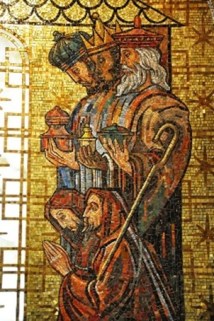
The Old King Brought the Gold

We are in a new year, and about to celebrate the Epiphany (Three Kings Day) on January 6.  The legend of the three kings who were guided by starlight to find yet a fourth king is well-celebrated in Christian literature and ritual, but maybe it has something to tell us about old age – then and now.

The only place the kings/magi are mentioned is in the Gospel of Matthew, and it doesn’t even specify how many there were: “After Jesus was born in Bethlehem in Judea, during the time of King Herod, Magi from the east came to Jerusalem and asked, ‘Where is the one who has been born king of the Jews? We saw his star when it rose and have come to worship him.’” Matthew does tell us that they brought three gifts – gold, frankincense and myrrh – so early Christians apparently extrapolated their number from this.  But the short note from the Gospel was far too simple a story for Christians, and soon the kings had names, domains, and camels.  They also had ages, and are often depicted as ranging from young to old as in this stained-glass window from the National Basilica:

Picture1

According to legend, the oldest king or magi was Melchior, King of Persia. The gold he brought was in accordance with the prophecy in Isaiah (Isaiah 60:6).  As I said, we sometimes forget that the nativity gospel – shepherds, kings, manger – only occurs in Matthew and Luke, and the magi only appear in Matthew.  We also (conveniently) forget that the story that Matthew tells makes the magi responsible for the Massacre of the Innocents, because they warn Herod of the existence of a threatening child.  This episode is almost always left out of the retelling of the Christmas story.  Perhaps for the best.

The kings appear in various poems and stories, with one of the most famous being T. S. Eliot’s “Journey of Magi” which begins with these words:

‘A cold coming we had of it,
Just the worst time of the year
For a journey, and such a long journey:
The ways deep and the weather sharp,
The very dead of winter.’

Note that there are single quotes around this first section; in fact, they were lifted from a Nativity sermon that Lancelot Andrewes preached to King James in 1622. Andrewes was best known for translating the Bible into the lovely King James version published, in 1611.  He was specifically responsible for the first four books of the Bible (giving us the eloquent creation story in Elizabethan English), and generally oversaw the rest of that monumental project.  In 1622, when he preached the Nativity sermon quoted above, Andrewes was sixty-seven, an advanced age in those days, and assuredly feeling the “dead of winter.”  He jokes in the sermon that we do not have the faith of these Gentile kings, that we do not like the hard going in the cold weather: “Best get us a new Christmas in September,” he chides.  Living through the bruising temperatures of this past Christmas, I have sympathy.

Art and literature have made much of the three kings – there are many poems besides Eliot’s, including notable ones by Longfellow and Yeats.  Yeats makes all the kings old: “With all their ancient faces like rain-beaten stones.” Various books and stories have used the story in some way, most famously O. Henry’s “Gifts of the Magi.

The magi are much celebrated in Christmas pageants and on Epiphany, “Three Kings Day” being the time of gift-giving in many cultures. But I am most interested in the legends that assigned age and gifts to the magi.  If the legends were created now would the old king bring the gold? Would the oldest of us have been paired with the most valuable gift?

Eliot ends his poem thus, in the voice of one of the kings (we don’t know which one):

…were we led all that way for
Birth or Death? There was a Birth, certainly
We had evidence and no doubt. I had seen birth and death,
But had thought they were different; this Birth was
Hard and bitter agony for us, like Death, our death.
We returned to our places, these Kingdoms,
But no longer at ease here, in the old dispensation,
With an alien people clutching their gods.
I should be glad of another death.

Sometimes I think all old people, in this youth culture of ours, feel like aliens among people who are “clutching” at gods or values we don’t recognize.

But come the kings did and legend gave them names, countries, and specific gifts. Matthew’s Greek text dubbed them magi, a word that denotes wisdom as well as authority.  The most ancient, Melchior, brought the gold, which was said to symbolize Christ’s kingship.  Was this gift purposefully assigned to the oldest of the three?  Frankincense was said to denote worship, myrrh was used in the preparation of dead bodies and foretold death.  Myrrh might have seemed to be the most appropriate for the oldest man.  But, no.  In an age when true elders were few and appreciated for accumulated knowledge, it was Melchior who endowed the symbol and mantle of kingship.

Lastly, we might remember that January 6 was also the date of the Capitol Insurrection.  Where were the wise men on that day of Epiphany?