Guns, Mortality, and Old Age

During WWI, Freud wrote an essay entitled “Thoughts for the Times on War and Death.” I recommend it. He says that WWI is a “new” kind of war in its disregard for noncombatants, the wounded, and any rules of engagement. Freud points out that the Great War brought two forms of disillusionment – one having to do with the illusion of the true nature of man and nations and the other regarding our illusion that death either does not exist or is very far away. Massive disruptions and killings make us face the fact that death is close, just as far away as the next trip to the mall. “Death will no longer be denied; we are forced to believe in him. People really are dying, and now not one by one, but many at a time.” So it felt to Freud in 1915; so it feels to us today. People are dying in a way that seems senseless and makes us feel defenseless.

The recent (and continual) rounds of massacres of the innocent scare us with their demonstration of the thin veneer of civilization. They also remind us of our mortality in a way that other things do not. Tactful news outlets do not publish the bloody photos; however, our imaginations are as graphic as any photo. Regardless of how healthy we are, how many sit-ups we can do or how often we get a mammogram, it could be us.
One would think that the older we got, the more we would make friends with death. He is a neighbor, after all, and we have many mutual acquaintances. If you live in an area dense with retired folk, the way I do, deaths come along at a regular pace – sometimes long-expected and sometimes suddenly, but yet we cannot quite believe that it could be… me. Yes, we know we will die; we simply do not quite realize it most of the time.

Our generation grew up under the shadow of the atom bomb. We should know death is never far away. I was a child in Florida during the Cuban missile crisis – we were well aware that we were within reach of short range missiles. My father dug a fallout shelter in the crawl space under our house and stocked it with rice and canned goods. We slept upstairs knowing that someday we might have to retreat to the earthen cavity to end our days, and yet time passed and so did that awareness. It is, indeed, amazing that mankind has not used this technology of destruction in the past seventy-four years. Especially since, let’s face it, we cannot even control the use of AR-15’s.

So we look into the face of random death again. Freud says that facing this unwelcome truth is no entirely a bad thing. It “has the merit of taking somewhat more into account the true state of affairs and of making life again more endurable for us… . If you would endure life, be prepared for death.”

None of this is to say that we should not do something about the violence that surrounds us, should not try to re-establish a civilized society where fear does not govern. If civilization could control the atom bomb for all these years, it would seem we could exert an effort to stop gun rampages, and we should do everything we can to do so. And if we find that the fear that guns engender is to the benefit of any person or agenda, we should wonder about why that is and what we can do about it.

My story this week, “A Spoonful of Sugar,” is about one woman’s insight into her own mortality. I recommend the Freud essay and also recommend Ernest Becker’s book Denial of Death.
Turning Things Upside Down in Old Age

Young people look forward – forward to the day when they can carry a cell phone, drive, leave home, marry, have children. There is a long and hopeful future ahead of them. On the other hand (according to Victor Hugo), elders live in “a cottage with a balcony on the edge of the abyss.”

Old peoples’ future is not nearly so long as their past, so they tend to look backwards – a reversal that happens sometime in our late sixties (in my opinion). Events, creeping mortality, and the mirror all jostle our perspective until it… flips. From that point, it appears that we are looking at the world from a different angle than other, younger people. One is reminded of Lewis Carroll’s poem:

“You are old, Father William,” the young man said,
“And your hair has become very white;
And yet you incessantly stand on your head—
Do you think, at your age, it is right?”

“In my youth,” Father William replied to his son,
“I feared it might injure the brain;
But now that I’m perfectly sure I have none,
Why, I do it again and again.”

Old people may be forever standing on their heads. This is not such a bad thing. G.K. Chesterton talks about the value of seeing the world upside down (literally):

If a man saw the world upside down, with all the trees and towers hanging downwards as in a pool, one effect would be to emphasize the idea of dependence. There is a Latin and literal connection; for the very word dependence only means hanging…. But the point is this: that whereas to the normal eye the large masonry of its [the town of Assisi’s] walls or the massive foundations of its watchtowers and its high citadel would make it seem safer and more permanent, the moment it was turned over the very same weight would make it seem more helpless and in peril. It is but a symbol; but it happens to fit the psychological fact.

Needless to say, the turning of the world upside down more or less voids the idea of progress. I have talked about progress elsewhere, but it is worth noting again that after the midpoint of life (the peak of Dante’s parabola), the human body is not progressing; the modern aging person lives with the myth of progress while living… the opposite.
But there is hope. Dante describes an upside down world in his Inferno – one goes down only to come out on the other side:

You were there as long as I climbed downward.
When I turned myself round you passed the point
To which all weight on every side pulls down.

And now you come under the hemisphere
Opposite that which domes the vast dry land:
There, beneath its pinnacle of sky… (Canto XXXIV)

Dante and Virgil, of course, emerge in Purgatory, which is not yet heaven (but is far nicer than hell). Remember when you were very young and thought you could dig a hole to China? If you could have done so, you would have tunneled down to the center of the earth and then started going… up. There are also the mythological upside-down trees of the Bhagavad Gita and Norse sagas.

This ability to look back is a blessing of old age. In Mrs. Dalloway, we find this passage:

The compensation of growing old…was simply this; that the passions remain as strong as ever, but one has gained – at last! – the power which adds the supreme flavour to existence, the power of taking hold of experience, of turning it round, slowly, in the light.

And in All Passion Spent, Lady Slane calls “looking back on the girl she had once been” as the “last, supreme luxury…. She could lie back against death and examine life.” Old age has its benefits.

And where do we old people come out in our upside-down world? Hopefully, with a new perspective. I love to hike and I have often noted that when going the opposite way I usually travel on a loop, it almost seems like a different path! In retrospect, we may see events in our lives from the standpoint of how they came out rather than what the intention was. We are more likely to forgive mistakes (our own and others – for who could bear the past without forgiveness?) and learn the lessons we missed in our initial shame and regret. From this new standpoint, we also realize that what we thought was good fortune was often disaster in disguise. All this makes us less sure that we know all the answers, but perhaps more sure about what the important questions are. Maybe we are on Hugo’s porch hanging over the abyss, but – nevertheless – we are enjoying the long view down.

And it is just not our personal story; we have lived long enough to see changes in our world. Our generation has seen technology emerge around us and then submerge us all. We have seen what is commonly called progress, but, in retrospect, we are not entirely sure how progress should be defined.

This week’s story, “Two New Apps,” is about technology and love and truth. Enjoy.


Short Benediction for W. S. Merwin

The poet W. S. Merwin died yesterday at the age of ninety-one.   My favorite Merwin lines come from his poem “Air” :

This must be what I wanted to be doing,
Walking at night between the two deserts,
Singing.

Think about it.  The desert we come from and the desert we are headed for.  Meanwhile, sing.

Poets are influenced by other poets, and when I read “Air” (written in 1963), I hear an earlier poem (1895) by Stephen Crane:

I walked in a desert.
And I cried,
“Ah, God, take me from this place!”
A voice said, “It is no desert.”
I cried, “Well, But —
The sand, the heat, the vacant horizon.”
A voice said, “It is no desert.”

This, by the way, was from Crane book of poetry The Black Riders,  which the poet said he liked far more than his very successful novel, The Red Badge of Courage.

But this is a homage to Merwin, who actually wrote a poem called “For the Anniversary of My Death“:

Every year without knowing it I have passed the day
When the last fires will wave to me
And the silence will set out
Tireless traveler
Like the beam of a lightless star

Then I will no longer
Find myself in life as in a strange garment
Surprised at the earth
And the love of one woman
And the shamelessness of men
As today writing after three days of rain
Hearing the wren sing and the falling cease
And bowing not knowing to what

If you were to write a poem or a letter to commemorate the anniversary of your death, what would you say?  Here is another example from Frost’s “A Lesson for Today“:

I hold your doctrine of Memento Mori.
And were an epitaph to be my story
I’d have a short one ready for my own.
I would have written of me on my stone:
I had a lover’s quarrel with the world.

And then there is this from Stevenson’s “Requiem“:

This be the verse you grave for me:
Here he lies where he long’d to be;
Home is the sailor, home from sea,
And the hunter home from the hill.

Go back and read Merwin and then think about the anniversary of your own death, the epitaph for your stone, a summary of your life.  But please read Merwin, who gave us words to help us sing between the deserts.


My Grandfather’s Clock

I had the song, “My Grandfather’s Clock,” tick-tocking in my head this morning. A metrical earworm. The ditty tells the remarkable tale of a mechanical device (which actually needs regular winding!) that lasts ninety years – it was “bought on the day” the man was born and only stopped when he died. Do you know it? It was a favorite in New England first grades and with barbershop quartets. (Johnny Cash even recorded it.) Apparently there are many verses, but here is the verse and chorus that I remember:

My grandfather’s clock was too tall for the shelf
So it stood ninety years on the floor
It was taller by half than the old man himself
But it weighed not a pennyweight more

It was bought on the morn on the day that he was born
It was always his treasure and pride
But it stopped, short, never to go again
When the old man died

This song is said to have given the name of “grandfather” to such clocks. Not sure that is true – I’m beginning to think you can find any fact you want on the internet (as well as its contradiction). But it seems to have been written by Henry Clay Work – an American who heard a similar story when he visited an English pub in North Yorkshire.

Anyway, the timepiece went on “like clockwork,” only being asked to be wound every night (the old version of recharging), and kept perfect time for the duration of the old man’s life. What do we oldsters possess which has served us all or most of our whole lives? Surely nothing mechanical, I would guess. How many radios, cars, televisions, alarm clocks, have we gone through? Technology may be laboring to extend the life of humans, but machinery/equipment is expendable. And more and more so. If its obsolescence isn’t built into its very design, it is soon deemed outmoded by “better” technology that we surely much have to keep up with. And don’t try to get parts for a thirty-year old oven. (The EU, as well as some states, is actually considering legislation to make appliances last longer and be easier to repair.)

And then there is the Marie Kondo craze, spreading the credo to ditch most of our “stuff” and keep only those things we love, the things that spark joy. The result has been a bonanza for thrift shops and Salvation Army stores as people unload their accumulations – and how long before it is replaced? Do we also take the advice to love and take better care of what we have already? And not to abandon it for the newest version or fad?

People my age who are beginning to think about down-sizing or moving to an old age holding station (let’s call it what it is) all have one complaint – they have too much stuff. And, often, the stuff they prize – grandma’s china, Aunt Ruth’s silver, the gigantic wardrobe that’s been in the family for years – no one in the family wants. Who would polish silver these days when it could be melted down to buy a new iPhone?

What does this mean about how we view our environments? Does cultural disposability as it relates to our objects somehow also seep into the way we treat the world around us – our environment, other people? Just a question to ponder. The grandfather clock was dependable and long-lived because it was well and durably made, but it was also reliable because its owner remembered to wind it every night. And to oil and polish it occasionally. To pay attention to it. And deeply appreciate it.

Anyway, writing this post has finally gotten the song out of my head. If you want to read a piece of my fiction about one woman’s attachment to her chiming clock (and other things), try “Playing by Ear.”

Ripeness and Readiness

In an essay on “Late Style in Beethoven,” the philosopher Theodor Adorno starts out with this comparison of old age and fruit:

The maturity of the late works of significant artists does not resemble the kind one finds in fruit. They are, for the most part, not round, but furrowed, even ravaged. Devoid of sweetness, bitter and spiny, they do not surrender themselves to mere delectation… and they show more traces of history than growth.

Putting aside the specific discussion of “late” creativity (a subject I will come back to in a future blog, surely citing Adorno’s essay, Edward Said’s On Late Style, and the fascinating Old Masters and Young Geniuses by David Galenson), I am more interested in the simile presented, comparing age to ripe fruit. It is a trope often used; Cicero repeatedly compares old age to ripeness (maturitas). But, in true old age, our fruit is beyond its peak (as much as we would like to think otherwise). It is often dry, withered. It might even start to ferment.

Shakespeare considered the issue of ripeness and indirectly compared it with readiness. In Hamlet (surely the story of the tragedy of youth) and King Lear (a tragedy of old age), in precisely the same point near the end of the play (Act V ii in both cases), we are faced with the conclusion that either readiness is all or ripeness is all. First (in 1603 or thereabouts) we hear the young Dane:

HAMLET: We defy augury. There’s a special providence in the fall of a sparrow. If it be now, ’tis not to come. If it be not to come, it will be now. If it be not now, yet it will come—the readiness is all.

Readiness connotes preparation, and a proactive stance toward a situation. Hamlet may dawdle, but he finally is ready to do something. He has agency over the readiness.

In Lear (five or six years later), it is not the title character that proclaims that ripeness is all, but Edgar, talking to his blinded and despairing father Gloucester:

GLOUCESTER:  No farther, sir; a man may rot even here.

EDGAR:  What, in ill thoughts again? Men must endure
Their going hence, even as their coming thither;
Ripeness is all: come on.

GLOUCESTER:  And that’s true too.

Men must endure their going hence, even as their coming thither. This is interesting, because (like many of us I would guess) my young “going hence” was even more angst-ridden than my late life “coming thither.” In the scene above, Gloucester wants to go no farther: A man may rot even here. Surely we will grow old wherever we are and, yet, his son encourages him to keep going. And the paradox is that Gloucester, poor blind, disillusioned Gloucester, recognizes that both things are true. And that’s true too. We must age and yet we must go on. It is of note here that when Nahum Tate bowdlerized the Bard to produce an upbeat version of Lear in 1681, it was Tate’s happier version that ran almost steadily until 1838. And in Tate’s unauthorized edit, the line about ripeness just disappears. Apparently, we are more willing to accept the demands of readiness than the inevitabilities of ripeness.

Yves Bonnefoy writes that ripeness and readiness are “the two irreducible attitudes. One the quintessence of the world’s order, the unity of which one seems to breathe; the other, the reverse of that order….” Ripeness connotes a passive passage of time; readiness signals a capacity for action. And, as Gloucester says, both are true. However, the readiness of old age has to be in the context of ripeness, even over-ripeness or decay. There were only five or six years between the writing of Hamlet and the appearance of Lear. Both are tragedies. Both examine a portion of the arc of life – one going up and one coming down. And both have something to teach us, perhaps, about balancing action with acceptance.

For many years, I attended a Great Books week in the summer; we read six works in advance and discussed them with the same group over six days. It was terrific and I would heartily recommend it. At one point I tried writing a novel about the experience – but after a few hundred pages, I did not think it was worth completing. I did, however, complete a chapter in which the group discussed King Lear; I attach a draft here. If you haven’t read the original lately, you might want to revisit the story of an old person who thought he had it figured out.

Becoming and De-becoming

As I mentioned in my last post, I have been hobbled with a broken foot. I was carrying on quite well (perhaps too well) until I went to what I thought would be my last appointment with the orthopedist – looking forward to leaving the office with my cumbersome boot under my arm and destined for the trash bin. Instead, I was told that my foot hadn’t healed; we would have to give it at least another month and see what was happening. I did not take it well.

It is true that I have osteoporosis. I take calcium, eat a ton of yogurt, and exercise regularly, but my genes and my age have caught up with me. My body is breaking down and taking longer to repair itself. Eventually, of course, it will be beyond repair (some might say that it has already gotten to that point). In the course of my daily meditation, I repeat the five recollections (Upajjhatthana Sutta), the second of which is “I have a body which is subject to aging and decay; I am not beyond aging and decay.” I have been repeating these words for years, but somehow I don’t seem to want to believe them. None of us does. And yet, none of us is beyond aging and decay.

I have referenced Hermann Hesse’s Hymn to Old Age before, and I recommend it heartily. There was a critical article about Hesse in a recent New Yorker – even the title was negative: “Herman Hesse’s Arrested Development.” Hesse did try to catch the soul of the young, and this review emphasizes such works as Demian and Siddhartha, but neglects The Glass Bead Game – or, more accurately, points to it only in that it includes young men living celibate lives in perpetual school. Unfair, I think. Hesse wrote prose and poetry into his old age; The Glass Bead Game (particularly cited when Hesse was awarded the Nobel Prize) was published when he was in his sixties and has much to say about being old and being young. The compendium of his words in and about old age which I reference above is a treasure.

In any case, Hesse has this to say about the process of “de-becoming” – a term I have come to appreciate:

For the task, desire and duty of youth is to become, and the task of the old man is to surrender himself or, as German mystics used to call it, ‘to de-become.’ One must first be a full person, a real personality, and one must have undergone the sufferings of this individualization before one can make the sacrifice of his personality.

And this, again, reminds me of Buddhism, where “becoming” is not always a good thing, while Nibbana or “extinction” of desire is indeed to be wished for. Bhikkhu Bodhi, a great Buddhist scholar and translator puts it like this:

In the end he must choose between the way that leads back into the world, to the round of becoming, and the way that leads out of the world, to Nibbana. And though this last course is extremely difficult and demanding, the voice of the Buddha speaks words of assurance confirming that it can be done, that it lies within man’s power to overcome all barriers and to triumph even over death itself.

Like it or not, as we age we are “de-becoming” what we used to be – body and mind. It is a sacrifice that we make whether we do so willingly or not. But perhaps the measure of a Hesse’s “full person” is that one can surrender willingly, even joyfully. I have not gotten there yet, but the forces of nature are working on me.

This week’s piece of fiction (“May 12, 2036”) is an exercise based on Jorge Borges’ short story “August 25, 1983,” wherein the great Argentinian writer imagines meeting himself in the future on his own deathbed. (He died in 1986, so was off by three years.) It is an intriguing story and a good model. Read my story if you like, but please do read the Borges. And try the exercise yourself.

Eden

Many dementia patients – including my mother – revert to the past. In my mother’s case, she escapes to a time before she had a husband or children. Experts in dementia say that age eighteen or nineteen is often where such patients end up. She looks for her parents, for houses and gardens she lived in long ago. Wonderful places. Gardens of Eden where she has no worries, where there is no shame or aging or death. And perhaps we are all looking for such a place. Perhaps we are all trying to return to Eden.

Before the era of progress, all of western culture looked back to Eden. Man had degenerated from the original Eden, from the original Golden Age. And so had the earth. Erosion of mountain peaks and the shortening of the life span from the amazing Biblical ages pointed to a world in the state of slow but continual degeneration. But then, somewhere along the line, we started to look forward rather than back as a civilization. The shift on the macro level, however, has not seemed to make a difference to the old demented person who is sure that her mother is waiting for her somewhere with a bowl of warm tapioca pudding.

Admit it. We all do a little of this backward-looking – we all remember Christmases that had a special glow or a magical childhood hiding place. We all, sometimes, want to return to Eden. But it can’t be done – or at least not easily. James Baldwin put it best:

Perhaps everybody has a garden of Eden. I don’t know; but they have scarcely seen their garden before they see the flaming sword. Then, perhaps, life only offers the choice of remembering the garden or forgetting it. Either, or: it takes strength to remember, it takes another kind of strength to forget, it takes a hero to do both – Giovanni’s Room.

In order to go back, one has to toss aside all that has been accumulated through the years. Renounce it. Religions say that this is one way to come to fulfillment:

The purpose of all valid spiritual disciplines, whatever the religion from which they spring, is to enable us to return to this native state of being – not after death but here and now, in unbroken awareness of the divinity within us and throughout creation… that state, is the Eden to which the long journey of spiritual seeking leads…. (E. Easwaren)

And some say that to grow up, we must leave Never-never Land behind us. In the old and confused, though, it is perhaps a safe haven. They go back to what doctors sometimes call a “reminiscence bump” from earlier life. Faced with physical and mental infirmity, the specter of death and the loss of a familiar world, these elders can go back in their minds to the haven of their youth. And perhaps we should be glad they can.

Where (and when) was your Eden? And have you tried to get it back through effort and acquisition (buying a house like the one you grew up in) or by renunciation? Have you forgotten it? Or are you one of Baldwin’s heroes who can acknowledge it and yet move on?

The story for this week (“Back to the Garden“) is not about elders, but it is about those who are facing the end and the garden where things start and things stop. It is also a tribute to Joni Mitchell and her exhortation in “Woodstock”: “We’ve got to get ourselves back to the garden.”

Notes on Faust

I just came back from visiting my mother in Memory Care. A few days spending time with patients in various stages of health and dementia has gotten me thinking about Faust again – about the Faust legend in general terms and what kind of Faustian bargain we might have made and be making for the miracles of life extension.

Spengler called Faust the fundamental myth of Western Civilization and this myth has been tackled by great authors from Marlowe to Goethe to Mann to Bulgakov. In case you have forgotten, Faust is a scholar who sells his soul to the devil in return for knowledge, power, wealth. Faust supposedly traces back to an historical figure in early 16th century in Germany, and was kept alive because it struck a deep chord in those who heard it or read it – in farcical plays, in fireside tales, or in early chapbooks.

“Not enough Fausts are written. Everyone should write one,” said Ludwig von Arnim in the early 19th century. In fact, we all write one with our lives. For what are we willing to sell our souls? I, in fact, wrote a “Faust” novel a few years back (the prologue to A Kind of Joy or An Essay with Characters is here), and the exercise forced me to think about this question and how other authors have dealt with it. Marlowe’s Faust asked for magic, Mann’s wants to create great musical compositions, and Goethe’s wants never to be bored. The Faust I created was a woman, and she wants the opposite of what Goethe’s Faust wanted – my fictional Faye wants contentment, peace. For that she is willing to sell her soul. But that is a story, a thought experiment.

If the Faust legend is the central myth of Western culture, of the Enlightenment, then what has our culture bargained for? Like Goethe’s hero, we surely don’t want to be bored; one might wonder what we have sold our attention for. And we don’t want to die. In most of the Faust stories, the protagonist gets twenty-four years before the soul must be handed over. But twenty-first century people do not want to die at all, and has continually increased life spans until our bodies often last much longer than our minds. Science may solve this problem, but don’t count on it. And thus we keep building “Memory Care” facilities to house our bodies, and we keep uploading our pictures and memories to the cloud to ensure that they are not lost forever. I don’t have an answer. Science has done wonders in eradicating disease (think of polio vaccine!), disability (think of cataract surgery!), and the debilitations of old age (think of hip replacement!). It has also made many deadly diseases into simply chronic ones (think of insulin!). But it has not yet enabled our minds to function as long and well as our bodies do.

In the end, most fictional Fausts learn their lesson. Sometimes they lose their lives and souls (Marlowe) and sometimes they recant and the author rescues them at the last moment (Goethe). It doesn’t really matter. The important point is to consider what we sacrifice in life for what we receive. It is easier to think about the rewards and not the payment, but there is that unavoidable moment when payment comes due (Goethe notwithstanding). My mother has lived far longer than her parents or grandparents, but finds herself in a mental state that they never had to experience. Our planet has afforded most of us in the West lives of comfort and plenty, but now our seas are rising and our summers are stifling. Faustian bargains are traditionally with the Devil, but perhaps we could think of the Devil as representing our more impulsive nature, of the tendency to favor immediate gratification over the long-term good. In any case, it is an interesting problem to think about.

Faust might be an especially good legend to contemplate in our old age. In Goethe’s version, it is the old mythological couple, Baucis and Philemon, who stand up to the land-developing, greedy Faust. They refuse to sell out and move from the remote bungalow and thus anger Faust: “Their stubbornness, their opposition/ Ruins my finest acquisition.” Needless to say, they lose (and die), but they will forever stand on the moral ground. In the remoteness of old age – past the time of ambition and acquisition – maybe we can see the ramifications of the Faust myth more clearly  than our children. It is worth thinking about. What did you sell your soul for? What would you sell your soul for?

Parabola and Long Tails

I wrote earlier in this blog about Dante’s vision of life as a parabola, which goes up to the “perfect age” (thirty-four according to Dante) and then starts down again. Life rises on one side and falls on the other, ending on the same level where it began. And so, as it falls, it passes through some of the same horizontal levels passed through on the way up – something that intrigues me, but which I will come back to.

If life for Dante was a parabola, I have wondered whether – seven centuries later – the shape of life has changed. Children (and mostly I mean well-off children) now seem to have a longer childhood. They stay at home longer, marry later, have children later. On the other side, old age is often very long indeed in the modern era. Medicine and technology have allowed life to be extended again and again, until the tail just lengthens and lengthens. Without judging whether this is a good thing or not, it surely changes the shape of a life. My mother, for example, has been old for a very long time. She has had multiple joint replacements and cancer surgeries, but is remarkably healthy as she approaches ninety – except that she has severe dementia. Scary dementia where she is sure that people are watching her, harming her, planning all manner of evil. And this could go on for a very long time. For better or for worse, old age seems to have developed what statisticians call a “long tail” – rather than dipping down precipitously at the end (think parabola), it tapers off as more and more is lost, and yet the heart goes on and so does some form of life. Where Dante saw the symmetry of a parabola, are we now seeing something else?

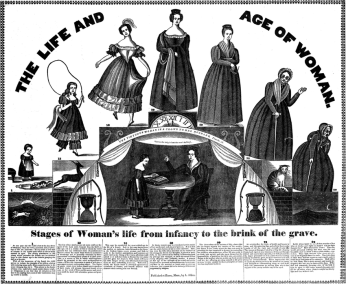
I like playing with the symmetry of Dante’s parabola. Over my desk hangs a nineteenth century depiction of the stages of a woman’s life – more an arc than a parabola but the idea is the same.

As I noted in my earlier post, the parabola gave me an idea for the structure of a novel which would pair points on the upward movement with corresponding points on the downward slope after the “perfect age” is reached. (Here is an interesting exercise – when did you reach your “perfect age”? Or aren’t you there yet? What is the difference between Dante’s perfect physical age and the perfect spiritual/mental age?) My novel is about two-thirds complete and will soon join its companions in my bottom drawer, but I thought I would post an excerpt. In order to illustrate and test my thesis that there are correspondences between the same point going up and coming down the life cycle, the novels pairs (fictional) diary/journal entries from the same woman, often on a common topic or theme.

The title of the novel is Hummingbird Wars and the excerpt includes two chapters/paired journal entries. In the this selection, we have a young mother being introduced to exciting new technology as the world opens up to VCR’s and personal computers in 1985. At the descending point on the parabola, the same woman in 2005 is nearing retirement, learning yet another version of the operating system at the office, and wondering about the true value of the internet, cell phones, and social media. If you are my age, you will recognize this woman (both the older and younger version) and her thoughts and concerns. If you are younger, you might wonder how your views of technology will change as you enter the long tail of old age.

Forgiveness and Remorse

Forgiveness is different in old age. In the hurry of youth and middle age, we often either push forgiveness aside or bestow it hastily in order to get on with things. In our latter years, old resentments drift out of the silence, out of the memory that cannot remember the word for that thing over there, but can recall all unkindnesses in great detail – the ones we received as well as the ones we perpetrated. Often those we want to forgive (or seek forgiveness from) are not available; they have passed out of our orbit through time, through death, through dementia.

Old age is teaching me many things and one of them is that the human condition is universal. Sympathy is replaced by empathy. There is no time or heart left for enemies. We are all friends in our common human afflictions. And David Whyte says that friendship is all about forgiveness. He says it “is a mirror to presence and a testament to forgiveness. Friendship not only helps us see ourselves through another’s eyes, but can be sustained over the years only with someone who has repeatedly forgiven us for our trespasses as we must find it in ourselves to forgive them in turn.”

And then there is the issue of forgiving ourselves.

Yeats wrote a poem that is a dialogue between the Self and Soul. Unlike similar medieval dialogues, the Self gets the final word here and it is about forgiveness:

I am content to follow to its source
Every event in action or in thought;
Measure the lot; forgive myself the lot!
When such as I cast out remorse
So great a sweetness flows into the breast
We must laugh and we must sing,
We are blest by everything,
Everything we look upon is blest.

“Casting out remorse” is easier said than done, but the result, according to Yeats, is a recovery of the innocence of Eden. In his “We must laugh and we must sing, / We are blest by everything,” the old Irishman sounds almost like Blake. Heaven all around us! But can we “cast out remorse” without doing something about it? David Whyte refers to the section of the Lord’s Prayer that implies in order to beg forgiveness ourselves, we must forgive “those who trespass against us.” It is a package deal. Of course, often the hardest person to forgive is oneself. I know.

I also find myself contemplating the need to beg forgiveness from this earth that we have been blessed with, out of which our kind was spun and nurtured. How it and its creatures have been abused in my lifetime! How can we ever atone!

Isak Dinesen too references the Lord’s Prayer in her sad story of watching giraffes from her beloved Africa being shipped to Europe:

The giraffes turned their delicate heads from the one side to the other, as if they were surprised, which they might well be. They had not seen the sea before. They could only just have room to stand in the narrow case. The world had suddenly shrunk, changed and closed round them.

They could not know or imagine the degradation to which they were sailing. For they were proud and innocent creatures, gentle amblers of the great plains; they had not the least knowledge of captivity, cold, stench, smoke, and mange, nor of the terrible boredom in a world in which nothing is ever happening….

As to us, we shall have to find someone badly transgressing against us, before we can in decency ask the Giraffes to forgive us our transgressions against them.

The giraffes and the polar bears and the elm trees and the monarch butterflies. Who can we forgive that will reciprocate the forgiveness we need from the world we are destroying? These are not easy questions, but they are on my mind.

Yeats says he is “ content to follow to its source /Every event in action or in thought; /Measure the lot; forgive myself the lot!” Measure first. A good carpenter will tell you to measure twice. Maybe realization is enough, but I’m not sure. I think I rather feel, with Dinesen, that more is needed before we can “in decency” throw off all remorse.

This week’s story is “The Iscariot” and references the most infamous sinner of all and describes a woman who sometimes feels like she is running a close second. And, perhaps, a different way to look at remorse and redemption.