Does Life Have Two Trajectories?

Often these days, there appears on my Facebook feed a picture of old people doing the can-can or surfing or jumping out of airplanes – and the caption is usually something like “Don’t worry about getting old, worry about thinking old.”  The first thing I think about when I see an old person behaving foolishly is how much they are going to regret that broken hip.  The second thing that annoys me is:  What in the world is the problem with thinking old?

I think better in my old age than I did when younger and sprier, and if I wanted to bare my soul, I have a past that would attest to this fact.  I might not think faster, but fast thinking and precipitous action were the problems of my youth, so slowing down is an improvement.  My body might be breaking down and groaning under the challenge to its endurance, but my body reminds me of my own limitations, of the real limitations of existence, of my mortality.  All of this leads to more realistic thinking, more comprehensive thinking, better thinking.

I have written several times about Dante’s parabola of life (for example see here), which posits a model wherein we are born and are on the upswing until we reach the “perfect age,” and then start on the downward slope.  Over my desk, I have a framed picture of an early American graphic on the “Stages of Woman’s Life from Infancy to the Brink of the Grave.”
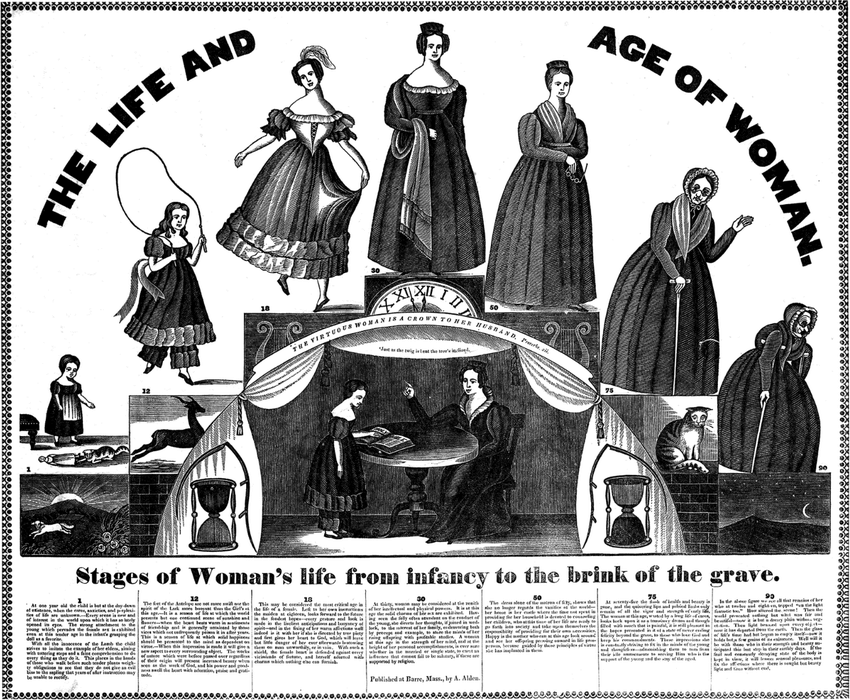
The-life-and-age-of-woman-stages-of-womans-life-from-the-infancy-to-the-brink-of-the

As you can see, life was seen as an arch, as a kind of parabola, with ascension to an apex, and then a relentless decline.  Extension of the life span (although life expectancy has actually decreased lately) and joint replacements may have shifted the curve a little, but one way or other the body breaks down.

Recently I read a variation on this in a discussion of Ladislaus Boros by Cynthia Bourgeault in the introduction to The Mystery of Death. The discussion posited that there were two lines to life, the physical parabola that Dante was so taken with and a “second curve”:

While the trajectory of the first (outer) curve leads, after that initial expansiveness of youth, toward greater and greater physical limitation and confinement, the trajectory of the second curve, when given full rein, rises irreversibly toward ever-greater interior freedom, expressed in those qualities of self-knowledge, personal agency, and the capacity to live imaginatively and richly within one’s interiorities. [I quote Bourgeault because Boros’ prose is prohibitively dense.]

 Mystery of Death presents the argument that the increasing physical limitations we are under in old age actually contribute to wisdom and bring us face to face with the real aspects of the world in which we find ourselves.  This is Boros (speaking always in the masculine voice): “He [the elder] loses his illusions: he learns to face up to disorder, suffering and inevitable frustrations, to accept them, to conform himself to them, and yet, to achieve something of lasting value.”

Not all kinds of knowledge and creativity improve with age.  David Galenson’s book on age and art, Old Masters and Young Geniuses, divides artists into two groups: conceptual geniuses who do innovative work early, and experimentalists, whose best work is the product of the slow accretion of learning, experience, and reflection – all of which occur in the later years.  There is a place for both.  We tend, however, to privilege young geniuses and resist acknowledging the “slow accretion” of careful reflection over time.

There is the trope of the wise old man or woman, and yet how many of us believe in it?  How many of us equate “thinking old” with stagnation, nostalgia, or senility?  If we don’t believe that our experience and time for reflection give us something of value, then we might as well go skydiving and try to prove (futilely, I am afraid) that we are still on an upward trajectory in some respect. And if we are wiser, how do we share that wisdom?  I have written elsewhere (“Teach Your Children Well”) of the difficulty and heartbreak of trying to help the young avoid our mistakes.

Many of my stories are about old people recognizing things they have learned – or, more often, realizing what they had failed to learn in their earlier years.  Most of these realizations are “little” learnings; I am still working on the bigger ones.  For an example of the former, you might try “Needs of the Living Organism.” 

What is the Place of Longevity?

“Like anybody, I would like to live a long life – longevity has its place.”– from Martin Luther King Jr.’s last speech

Lately, the place of longevity has been in politics.  Joseph Biden has just been elected to the presidency at age 77 (about which I am thrilled for reasons that have nothing to do with his age).  Up to this point, the oldest age at which any President had left office had been 77 (Ronald Reagan).  Over the years the median age of election to our highest office has been 55.

Joe is not the only one.  There will be a regular old folks home in the capitol.  Nancy Pelosi is 80 and Mitch McConnell is 78.  The three of them will probably hold power together over the next couple of years (barring an upset in the Georgia senate races).  What does it mean when old folks are in charge?  I am a great believer in the value of old age, but what exactly should be the place of longevity?

Most workers tend to retire in their 60’s if they can afford it.  The average age of retirement in the United States is 62, with 64% of the working population retiring between 55 and 64.  Retirement cannot be mandated (with some exceptions – the military for example). In 1978, mandatory retirement ages below 70 were made illegal; in 1986 Congress got rid of mandatory retirement ages altogether.

And I know what you’ll say: 70 is the new 60, 80 is the new 65.  Maybe.  We stay alive longer; medicine can fix our hearts, open our blood vessels, and replace our arthritic joints.  And in the old days (before the 19th century), it was deemed inappropriate to quit just because you got old.  In that era, age was not a legitimate excuse for retirement from the English House of Lords; men were not free from conscription until they were 61.  King Lear is a parable on the problems with retiring too early (or at all).  Dante condemned a Pope to Limbo because of what he called “The Great Refusal” – retiring from the papacy because of age.  Plato did not think anyone was even fit to rule until they were at least 50, and he gave no retirement age.

So, I’ve been thinking again about what it means to have the old folks in charge.  Over a decade ago, I was mulling this over as I wrote a novel (The Last Quartet) about a world where a flu (yes, indeed!) killed off everyone except the very old (who had gotten the first round of vaccinations) and the very young (babies who were born with some level of immunity).  I tried to imagine old folks raising children and building a new world from the ground up as the loss of almost all working people meant that technology and infrastructure fell apart.  (You can read a short story I wrote as an abstract for the book here.)  In my imagination, the old folks rose to the occasion; they had no choice.  And the young knew no other world, so they accepted the leadership of their extreme elders.  At least for a while.

But, back to Washington and the leadership there.   I do not have the energy that I used to have, and clearly our current leaders do not either.  More, they did not grow up in the same world as most of their constituents.  They may have wisdom (some of them surely do – others I’m not so sure), but wisdom is exercised through careful consideration and not the hectic pace of daily agendas and crises.  Aging gracefully is, in itself, a kind of wisdom.  I think of Jimmy Carter as a model of this. 

In Galenson’s wonderful book, Old Masters and Young Geniuses, the author divides the more capable among us as either conceptual geniuses who do there innovative work early (think physicists) or experimentalists, whose work is the product of the slow accretion of learning, experience and reflection.  The latter group does their better work in later years.  Where does politics fit into this model?  Or, one might ask, who in politics has any time for reflection and the slow accretion of learning?

In any case, we are about to witness the oldest leadership this country has ever seen at the same time that we are living in an age when change has never been faster.  You know by now that I think the old have much to offer to those around us, that old age can be a wonderful time of life.  But there are limits.  In the daily reminders or reflections of Buddhism, there is this: It is the nature of the body to decay and grow old.   We can deny it; we can push ourselves.  We can do well within the constraints of our age.  But it is a constraint – both to ourselves and our ability to relate to those around us.  And then there is the question of why we are seeing such longevity in our leaders; it could be they feel they have much to offer, but it could also be that power is sticky and difficult to shake off.  Or to want to shake off.  But elderly they are, and we will see.  I wrote my novel as a thought experiment; we are witnessing a real experiment.

In The Last Quartet, I was also thinking about the ability of the old to pass on wisdom, rather than knowledge.  You can read the prelude to that book here, but you need to come to your own conclusions.